
TL;DR:
- Advanced outdoor illumination involves layered design that enhances safety, aesthetics, and ecological responsibility. It uses ambient, task, and accent lighting with smart controls to reduce energy use, minimize light pollution, and highlight architectural features effectively. Proper planning, fixture selection, and restraint are essential for creating functional, beautiful, and sustainable outdoor lighting systems.
Most homeowners assume outdoor lighting means screwing in a porch bulb and calling it done. What is advanced outdoor illumination, then? It's a purposeful, layered design system that balances safety, dramatic aesthetics, energy efficiency, and ecological responsibility. It uses the right light in the right place at the right intensity, so your property looks stunning after dark without wasting power or washing out the night sky. This guide breaks down the layers, controls, ecological practices, and practical steps you need to transform your exterior.
Table of Contents
- Key takeaways
- The three layers of advanced outdoor illumination
- Smart controls for energy and ambiance
- Light pollution and ecological responsibility
- How to enhance outdoor illumination at home
- My honest take on outdoor lighting mistakes
- Transform your home with Co-starise permanent lighting
- FAQ
Key takeaways
| Point | Details |
|---|---|
| Lighting works in three layers | Ambient, task, and accent light each serve a distinct purpose and must work together for a balanced result. |
| Smart controls save real energy | Layered timer, photocell, and motion sensor controls reduce energy consumption by 30 to 50 per cent. |
| Colour temperature matters ecologically | Warmer light below 2700K reduces harm to nocturnal wildlife and preserves the natural look of your home's exterior. |
| Design for behaviour, not objects | Plan your lighting around how people move and use your space after dark, not just what looks interesting in daylight. |
| Darkness is part of good design | Purposeful shadows and negative space create depth, comfort, and a more dramatic visual result than flooding everything with light. |
The three layers of advanced outdoor illumination
Advanced outdoor illumination is built on a design hierarchy that professional lighting designers have used for decades. Understanding it changes everything about how you think about your exterior after dark.
The three layers are ambient, task, and accent light. Each one does a completely different job, and when you use all three together, the result feels natural, safe, and visually rich without any single source dominating the scene.
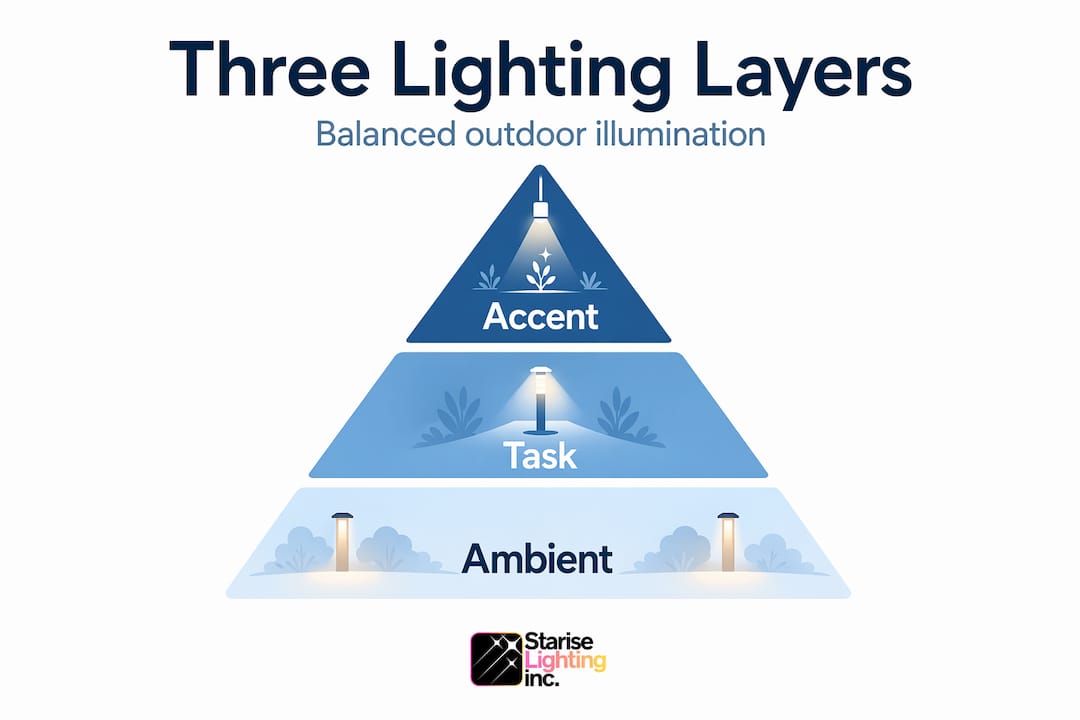
Ambient light handles overall safety and orientation. It gives your property a base level of illumination so people can see where they are without being blinded by glare. Think softly lit eaves, gentle post lights, or low wall-mounted fixtures that bathe an area in even, shadow-free light.
Task light serves navigation. It directs people along pathways, down steps, and toward entrances. This layer is precise and purposeful. A well-placed path light does not need to be bright. It needs to be positioned where a foot will land next.
Accent light is where the drama lives. This layer highlights your home's best features: a stone façade, a mature tree, a garden bed, or an architectural detail that disappears entirely at night without proper illumination. The techniques within this layer include:
- Uplighting (beam angles of 10° to 40°): Directs light upward to create height and drama on trees, columns, or façades
- Downlighting (beam angles of 30° to 60°): Mimics natural moonlight and works beautifully on pathways and garden beds
- Grazing: Positions fixtures very close to a textured surface to reveal its depth and character
- Wall washing: Floods a flat surface evenly for a clean, modern effect
The three-layer lighting hierarchy also solves one of the most common mistakes in residential outdoor lighting: over-illumination. When you flood everything equally, you flatten depth, create glare, and paradoxically make spaces feel less safe. Layering preserves the visual contrast that makes your brain read a space as comfortable and navigable.
Pro Tip: Before purchasing a single fixture, walk your property at night and note which areas feel unsafe or invisible. Those spots define your task and ambient needs. Let accent lighting be the last layer you add, not the first.
Smart controls for energy and ambiance
Modern smart outdoor lighting solutions go well beyond a simple on/off switch. The most effective systems use a hierarchy of controls that work together so your exterior responds to real conditions rather than a rigid schedule.
Here is how the control hierarchy typically works from the ground up:
- Astronomical timers set the schedule based on your actual sunrise and sunset times, adjusting automatically through the seasons without any manual input.
- Photocells respond to ambient daylight levels, overriding timers when skies are unexpectedly dark during the day or bright during dusk.
- Motion sensors activate specific zones when occupancy is detected, providing security and saving energy when areas are unused.
- Programmable dimming allows you to run fixtures at different power levels at different times of night, say 100 per cent until midnight and 30 per cent until dawn.
- App integration ties everything together, letting you adjust scenes, schedules, and brightness from your phone for events, arrivals, or seasonal changes.
Layered control systems reduce energy consumption by 30 to 50 per cent compared to fixed-schedule lighting. That is not a minor gain. On a whole-property system, it translates into meaningful savings month over month.
One detail most guides skip: control conflicts. If a photocell and a motion sensor are fighting for control of the same circuit, you get flickering lights or zones that never fully shut off. The correct logic is timer overrides photocell, photocell overrides motion sensor. Proper commissioning is what separates a system that runs smoothly for years from one that frustrates you weekly.
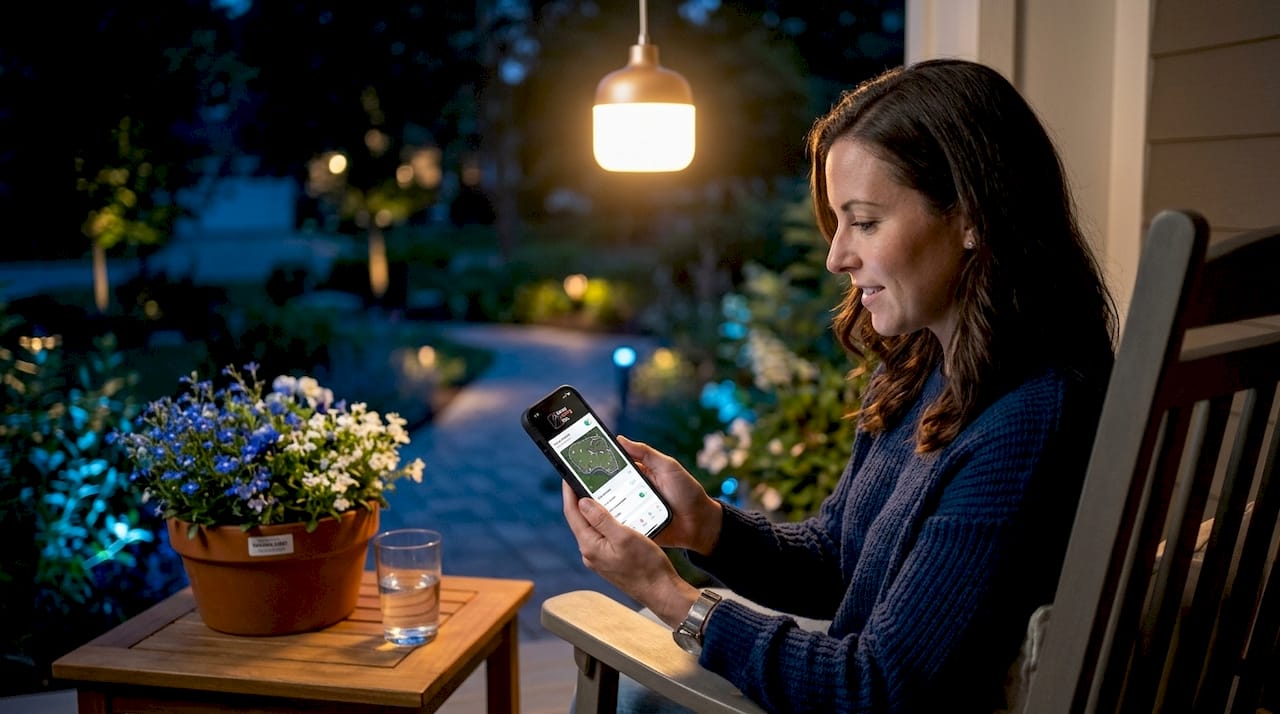
Smart lighting apps allow you to set distinct modes for daily life, dinner parties, or when you are away from home entirely. Arriving to a lit driveway and porch without touching a switch is a practical comfort that adds up quickly.
Pro Tip: Split your property into at least two control zones: front and rear. This lets you keep security lighting active out front while dimming the backyard for comfort during evening gatherings, with no compromise on either function.
Light pollution and ecological responsibility
This is the part most homeowners never think about until someone points it out. Your outdoor lighting choices affect more than your property. They affect the neighbourhood, local wildlife, and the quality of the night sky above your home.
Blue-spectrum light is the primary culprit. Short wavelengths scatter more in the atmosphere, contributing heavily to skyglow and disrupting the circadian rhythms of nocturnal insects, birds, and mammals. Standard white LEDs with a cool colour temperature (above 4000K) are particularly problematic.
Here is a quick comparison to help you choose wisely:
| Colour temperature | Skyglow impact | Wildlife disruption | Recommended use |
|---|---|---|---|
| Below 2700K (warm white) | Low | Minimal | Gardens, façades, residential areas |
| 2700K to 3000K | Moderate | Low to moderate | Pathways, entrances |
| Above 4000K (cool white) | High | Significant | Avoid for residential outdoor use |
Advanced lighting techniques address this through spectral tuning: selecting fixtures that favour longer wavelengths in the yellow and red range. Warmer colour temperatures below 2700K also make stone, brick, timber, and planting look far more appealing at night, so the ecological choice and the aesthetic choice are the same choice.
There is also the issue of dimming and spectral stability. Many standard LEDs shift toward blue as they dim down, which means your fixtures actually become more ecologically harmful at low output levels. DLC 5.1 certified fixtures are specifically rated for colour stability during dimming, ensuring the warm tone stays warm even at 20 per cent output.
The principle of "less is more" extends to physical placement. Shielded fixtures that direct light downward rather than outward reduce light trespass onto neighbouring properties and into the sky above. Designing with negative space, meaning intentional dark zones between lit areas, creates visual depth that no amount of extra wattage can replicate.
How to enhance outdoor illumination at home
You do not need to redesign your entire property to apply these principles. Here is a practical approach to how to enhance outdoor illumination at a residential scale:
-
Map your space after dark. Walk every area of your property at night and observe where people actually move, where you feel uncomfortable, and where the best architectural or landscape features are hidden. Lighting for behaviour rather than objects is the core principle of professional design.
-
Define your zones. Group areas by function: arrival and security zones, entertaining areas, garden and landscape features, and perimeter boundaries. Each zone may need a different approach to colour temperature, intensity, and control.
-
Choose fixtures with controlled optics. Look for fixtures that specify beam angles and include shielding or baffles. A fixture without optics sends light in every direction, creating glare and waste simultaneously.
-
Set your colour temperature before you buy. Commit to warm white (below 2700K) across the entire property for visual coherence and ecological responsibility. Mixing colour temperatures across a single façade looks fragmented and unplanned.
-
Plan for automation from day one. Retrofitting controls after installation is far more expensive than building them in. Even a basic astronomical timer reduces energy consumption significantly over a single season.
-
Choose weather-rated products. This matters more than many homeowners realise. In climates with cold winters, thermal cycling and moisture intrusion degrade cheap fixtures rapidly. Specify IP65 or higher rated products for any exposed installation.
Pro Tip: When exploring innovative garden lighting for planted areas, resist the urge to light every tree or shrub. Three well-lit focal points in a garden look far more intentional and beautiful than ten mediocrely lit ones. Restraint is a design skill.
My honest take on outdoor lighting mistakes
I've spent years looking at residential outdoor lighting projects, and the single most common error I see is treating brightness as a proxy for quality. Homeowners assume that more light means more safety, more beauty, more value. It rarely does.
What I've found is that over-lighting flattens everything. A façade flooded with harsh white light looks institutional, not welcoming. A garden bathed uniformly in bright fixtures looks flat, like a car park rather than a curated outdoor space. The houses that genuinely stop you in the street at night are lit with precision and restraint.
The other mistake I've seen repeatedly is designing lighting around what a property looks like in daylight. Shadows fall differently at night, textures read differently, colour disappears. The home you walk around at noon is not the same space you are lighting at 9 pm. Designing around after-dark behaviour and the actual visual geometry of night transforms the result completely.
What actually works is this: start with darkness as your baseline, add light only where behaviour, safety, or aesthetics genuinely require it, and treat every dark zone as deliberate rather than forgotten. That shift in thinking produces outdoor spaces that are comfortable, striking, and efficient all at once.
— Starise
Transform your home with Co-starise permanent lighting
If this article has changed how you think about your exterior, the next step is finding a solution that makes all these principles permanent and effortless. Co-starise specialises in exactly that.
Co-starise's permanent outdoor lighting systems are built on Gen 2 24V LED technology with colour-stable dimming, app control, and weatherproof construction designed for Canada's harshest winters. Every system is designed with layered control in mind, giving you the ability to set zones, scenes, and schedules from your phone. The fixtures are installed once and operate nightly without maintenance. If you want to see exactly how the integrated system works, Co-starise offers a detailed walkthrough along with expert consultation to help you plan a result that matches your home's architecture and your lifestyle.
FAQ
What is advanced outdoor illumination?
Advanced outdoor illumination is a design-led lighting approach that uses layered ambient, task, and accent light to balance safety, aesthetics, energy efficiency, and ecological responsibility. It goes beyond basic visibility to shape how a property looks, feels, and functions after dark.
How does smart outdoor lighting save energy?
Layered controls combining astronomical timers, photocells, and motion sensors reduce energy consumption by 30 to 50 per cent by dimming fixtures automatically and activating lights only when and where they are needed.
What colour temperature should outdoor lighting be?
Warm white fixtures below 2700K are recommended for residential outdoor use. They reduce skyglow, minimise disruption to nocturnal wildlife, and render stone, timber, and vegetation in the most flattering and natural tones.
Why is over-lighting a problem?
Over-lighting creates glare, flattens visual depth, and makes spaces feel less safe rather than more so. It also increases light pollution and energy waste. Purposeful layering with intentional dark zones produces far better results aesthetically and ecologically.
What is the benefit of DLC 5.1 certified fixtures?
DLC 5.1 certified fixtures maintain colour stability during dimming, ensuring warm-toned LEDs do not shift toward blue at lower output levels. This matters for both ecological impact and consistent visual quality throughout the night.