
TL;DR:
- Properly aimed outdoor lights improve safety by revealing ice and preventing slips during winter months. LED fixtures outperform traditional bulbs in cold temperatures and significantly reduce energy consumption throughout long winter nights. Continuous, weather-rated lighting at entrances and carefully selected materials ensure reliability, safety, and curb appeal during harsh Canadian winters.
Most homeowners treat outdoor lighting as an afterthought once snow arrives. But the role of outdoor lights in winter goes far beyond hanging string lights or leaving the porch bulb on. When temperatures drop and daylight shrinks to seven hours or fewer, your exterior lighting becomes one of the most practical safety tools your property has. It prevents falls on icy pathways, deters opportunistic crime, shapes how your home looks from the street, and, if chosen carefully, costs less to run than you might expect during those long dark months.
Key takeaways
| Point | Details |
|---|---|
| Safety before aesthetics | Properly placed lighting reveals ice texture and prevents slips on walkways and stairs during winter months. |
| LED beats everything else | LED bulbs perform reliably in freezing temperatures where incandescent and CFL fixtures often flicker or fail. |
| Continuous lighting at entries | Motion-sensor delays at doorways and stairs account for a significant share of winter slip-and-fall injuries. |
| Fixture ratings matter | Wet-location rated fixtures with corrosion-resistant hardware survive freeze-thaw cycles and road salt exposure. |
| Solar has real limits | Standard solar lights lose reliability in Canadian winters due to shorter days, cloud cover, and cold battery degradation. |
The role of outdoor lights in winter safety
This is where exterior lighting earns its keep. Not aesthetically. Not economically. Physically, by keeping people on their feet.
Winter walkways and stairs present genuine hazards. Ice can be nearly invisible under a flat overhead light, and snow compacted by foot traffic becomes just as treacherous. Poor visibility and lighting delays are associated with 75% of winter slip-and-fall injuries in cold-climate data from Illinois. That number alone should reshape how you think about your front path after November.
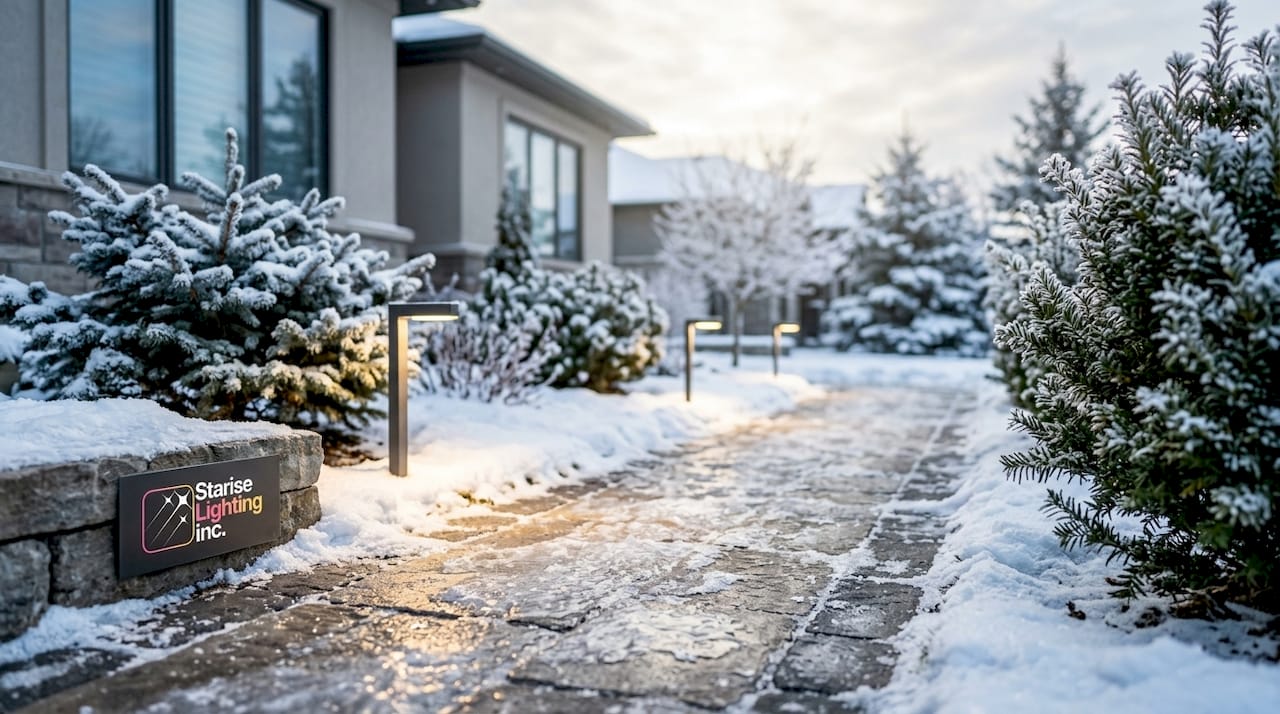
The solution is not simply more light. It is correctly aimed light. Fixtures aimed at 30 to 45 degrees downward reveal surface texture, making ice visible rather than glossing over it. Flat, overhead lighting reflects off snow and creates glare that actually conceals hazards rather than revealing them.
For practical fixture placement, the guidance that matters most is:
- Walkways require roughly 2 foot-candles of illuminance, and stairs need up to 5 foot-candles.
- Fixture height should be 24 to 30 inches above grade so fixtures stay visible and effective above typical snowfall accumulation.
- Spacing of 8 to 10 feet apart on one side of a walkway creates edge definition without creating a runway of blinding light down the centre.
- Critical entry points like front doors, garage entries, and side gates deserve permanently lit fixtures, not motion-activated ones.
That last point deserves its own emphasis. Motion sensors are useful in low-traffic areas of your property, but not at your front steps. Continuous entry lighting removes the activation delay that catches people mid-stride on slippery surfaces.
Pro Tip: Mark the locations of your path light fixtures with a tall stake or garden flag before the first heavy snowfall. This prevents snow blowers and shovels from damaging the fixtures and helps you find buried cables during maintenance.
Winter landscape lighting: beauty meets function
There is a genuine optical advantage to lighting a winter garden or front yard that most homeowners do not realise until they see it. Snow is a reflector. A single well-aimed uplighter on a snow-covered tree can produce three times the ambient glow you would get from the same fixture in summer. Winter landscape lighting ideas that ignore this amplification effect miss a significant design opportunity.
The most successful winter exterior lighting schemes layer at least three types of light:
- Path lights for safety and ground-level definition
- Post lights or lanterns for mid-height warmth and entry atmosphere
- Architectural or accent lighting for the façade, trees, and structural features
Decorative lights for winter, such as string lights wrapped around railings or draped through leafless trees, work particularly well in cold months because the bare branches create geometric patterns that summer foliage would hide. They add warmth visually without adding much energy cost when you choose LED versions.
The caution worth stating plainly is about glare. A reflective white snow surface amplifies poorly shielded light into a blinding wash that is uncomfortable and actually reduces visibility. Any fixture facing outward across a snowy yard should have a shield or hood directing the beam downward or toward the structure, not across the open ground.
The importance of porch lights in winter also extends beyond safety. A lit porch signals to neighbours and visitors that a home is occupied and cared for. During the grey weeks of a Canadian winter, that warm amber glow from a well-chosen lantern fixture does more for curb appeal than any summer planting.
Pro Tip: Choose a warm white colour temperature of around 2700 to 3000 Kelvin for winter exterior lighting. It reads as welcoming against snow rather than sterile, and it pairs well with the warm tones of stone, brick, and wood-toned exteriors common in Canadian homes.
Energy efficiency in winter outdoor lighting
Winter is when outdoor lighting runs the longest. In Calgary, Edmonton, and much of central Canada, daylight can be as short as 7.5 hours in December, which means your exterior lights may run 16 hours a day if set to dusk-to-dawn. The technology you choose for those hours makes a significant financial difference over a season.
The case for LED fixtures is not subtle. LED streetlights use 40 to 60% less electricity than traditional lighting, and the savings compound during extended winter use. At the municipal scale, Fairfax County's LED conversion programme reduced annual streetlight energy consumption from approximately 40 million kWh to 17.5 million kWh, saving roughly $1.4 million per year. The LED switchover also cut CO2 emissions by 32.4 million pounds annually. For a single household, the proportional savings are smaller in absolute dollars, but the percentage impact on your electricity bill is the same.
Here is a comparison of common outdoor lighting technologies for winter use:
| Technology | Cold-weather performance | Energy use | Typical lifespan |
|---|---|---|---|
| LED | Excellent. Performs better in cold. | Very low | 25,000 to 50,000 hours |
| Incandescent | Poor. Filaments fail in freeze-thaw cycles. | High | 1,000 to 2,000 hours |
| CFL | Unreliable. Slow to warm up in cold, may not reach full brightness. | Moderate | 8,000 to 10,000 hours |
| Solar (standard) | Limited. Battery degrades in cold; output drops significantly. | Near zero (but unreliable) | Varies |
| Solar (winter-rated) | Moderate. Sealed electronics and advanced battery management help. | Near zero | Varies |
Smart controls improve the picture further. Timers set to local sunrise and sunset, dimmer capability for late-night hours when foot traffic is low, and zoning that keeps entry lights on while reducing intensity on decorative zones all reduce consumption without compromising where it matters.
On solar lighting: winter-specialised solar systems require sealed electronics and larger battery sizing to handle reduced irradiance and cold-related battery degradation. Standard solar lights sold at most home improvement stores are not engineered for Calgary winters. They are a reasonable supplement in shoulder seasons but should not be your primary safety lighting from November through February. You can explore how permanent LED lighting compares in long-term cost savings for Canadian winters.
Pro Tip: Set your winter outdoor lighting to a timer rather than purely motion-sensor control for main pathways. A timed schedule from dusk to 11 p.m., then motion-activated through to dawn, gives you safety coverage during active hours and energy savings overnight.
Choosing and maintaining winter-ready fixtures
How to choose winter outdoor lights comes down to three things: the rating on the label, the material in the housing, and the height of the mount.
Ratings are not optional in a climate that swings between freezing rain and road salt spray. Every exterior fixture you install should carry a wet-location rating, which covers direct rain and snow exposure. Damp-location ratings are not sufficient for anything outside a covered porch. A sealed joint and corrosion-resistant hardware prevent moisture from entering and expanding during freeze-thaw cycles, which is the most common cause of fixture failure in cold climates.
Materials that hold up reliably include powder-coated steel, stainless steel hardware, and marine-grade aluminium. Bare iron or low-grade zinc fittings will rust visibly within one to two winters. Road salt is particularly aggressive on metals, and it travels further than you might expect through melt-water and splash from nearby streets or driveways.
Mounting height serves two purposes in winter. At the correct height, fixtures clear snowbank accumulation and stay effective. At the wrong height, even a moderate snowfall can bury path lights completely and create a hazardous trip hazard. Path lights should sit at least 24 to 30 inches above the expected snow line. Wall-mounted fixtures at entry points should be positioned so even drifting snow cannot block the lens.
Maintenance is simpler than most homeowners assume. A seasonal check before the first freeze should include:
- Wiping lenses clean of oxidation or dirt that reduces light output
- Inspecting all mounting hardware for rust or loosening from summer heat expansion
- Checking sealed joints for any cracking that could allow winter moisture entry
- Testing all bulbs and replacing any that are dimming, as winter-rated LEDs maintain brightness in freezing temperatures where other bulb types deteriorate
For Calgary homeowners specifically, the range of materials and fixtures suited to local conditions is covered in depth in this guide to exterior lighting materials for Calgary homes.
Practical strategies to get the most from winter lighting
Getting the most from your exterior lighting in winter is less about spending more and more about placing what you have thoughtfully.
- Aim fixtures at an angle, not straight down. Angled light reveals surface texture. Straight-down light flattens it. On icy steps, the difference is visibility versus invisibility of the hazard.
- Use continuous lighting at all primary entries. Front door, garage entry, and any side access point should be lit consistently from dusk, not triggered by motion.
- Zone your property. Keep safety zones (pathways, entries) on a continuous or timed schedule. Decorative zones like tree lighting or façade accents can operate on a shorter evening schedule to reduce energy use.
- Mark fixture locations before the first snowfall. Tall garden stakes placed next to each path light prevent damage from shovelling and help you monitor whether fixtures are still functioning beneath accumulated snow.
- Select LED bulbs specifically rated for cold temperatures. Not all LEDs are equal outdoors in winter. Look for fixtures rated to at least minus 40 degrees Celsius, which is the practical threshold for reliable operation across most of western Canada.
- Skip standard solar for primary safety lighting. Reserve solar fixtures for low-stakes supplementary zones. For entries and walkways, hardwired or low-voltage LED systems give you reliability when conditions are worst.
The outdoor lighting benefits in winter compound when you treat the property as a system rather than a collection of individual fixtures. When safety, decoration, and efficiency are planned together, every element reinforces the others. You can read more about how Calgary winters demand outdoor lighting specifically engineered for this climate.
What experience has taught me about winter lighting
I've seen homeowners make the same two mistakes year after year. The first is installing beautiful fixtures in October, watching them become buried and useless by December, and blaming the product. The second is putting motion sensors everywhere in the name of energy savings and then wondering why someone slipped on the front steps.
In my experience, the fixtures are rarely the problem. The planning is. Most people choose winter outdoor lighting the same way they choose summer lighting, without accounting for snowbank heights, ice-surface glare, or the fact that the sun sets at 4:15 p.m. in January in Calgary.
What I've learned is that the role of lighting in winter protection is deeply practical, not decorative at its core. Decorative value is real and worth pursuing, but it has to be layered on top of a safety foundation. When I look at a winter lighting scheme that genuinely works, it always starts with the question: can someone walk from the street to the front door safely in the dark, in a snowstorm, without thinking twice? If the answer is yes, then you can talk about how nice it looks.
My take on solar lighting in cold climates is blunt. The standard product is not ready for a Canadian winter. I have seen too many homeowners install solar path lights in September, watch them dim to almost nothing by November, and lose faith in low-voltage lighting altogether. It is not a technology problem overall. It is a specification problem. Winter-rated solar systems engineered with proper battery management exist, but they are not what most people are buying at the hardware store.
The single best thing you can do for your winter lighting this year is audit your entry points before the first frost. Walk your property at dusk and note every moment of uncertainty. Those moments are where the light is failing you.
— Starise
Upgrade your winter exterior with permanent lighting
If this article has you reconsidering what your property actually needs from its winter lighting, Co-starise offers a practical place to start.

Co-starise designs and installs permanent outdoor lighting built specifically for Canadian winters, using Gen 2 24V LED technology that performs reliably in freezing temperatures, functions through Calgary's harshest freeze-thaw cycles, and is controlled through a simple app. There is no seasonal takedown, no replacing blown bulbs in January, and no compromising between beauty and function. The system is weather-rated, professionally installed, and designed to provide safety, curb appeal, and energy efficiency across every season. If you are in Edmonton, Co-starise also offers winter-ready lighting in Edmonton tailored to local conditions. Reach out for a custom quote and see what your home looks like lit properly.
FAQ
What illuminance level is needed for winter walkway safety?
Walkways need approximately 2 foot-candles of illuminance, while stairs require up to 5 foot-candles. Fixtures should be mounted 24 to 30 inches above grade and aimed at a 30 to 45 degree downward angle to reveal ice texture rather than reflect off snow.
Why are motion sensors a problem for winter entry lighting?
Motion sensors introduce an activation delay at the exact moment someone is stepping onto a potentially icy surface. Continuous lighting at primary entries eliminates that delay and significantly reduces slip-and-fall risk during winter.
Do solar lights work reliably in Canadian winters?
Standard solar lights lose significant performance in winter due to shorter days, cloud cover, and battery degradation in cold temperatures. Winter-rated solar systems with sealed electronics and larger battery capacity perform better, but hardwired LED fixtures remain the most reliable choice for safety-critical zones.
What fixture materials hold up best in harsh winter conditions?
Powder-coated steel, marine-grade aluminium, and stainless steel hardware resist the corrosion caused by road salt and freeze-thaw moisture cycles. Every outdoor winter fixture should carry a wet-location rating to prevent internal moisture damage.
How much energy can LED outdoor lighting save during long winter nights?
LED technology uses 40 to 60% less electricity than traditional lighting options. During Canadian winters, when outdoor lights may run 14 to 16 hours per day, that efficiency gap translates directly into meaningful reductions on your monthly electricity bill.