

TL;DR:
- Certified lighting specialists provide precise photometric analysis, code compliance, and strategic design to optimize exterior lighting. They ensure security, energy efficiency, and rebate access while preventing over-lighting and light trespass issues. Working with a credentialed expert results in safer, more aesthetic, and cost-effective outdoor illumination.
Most homeowners assume that picking attractive fixtures is the bulk of exterior lighting work. Hire an electrician, choose something that looks good online, and call it done. The role of certified lighting specialists is far more specific than that assumption allows. Specialists bring photometric analysis, energy code compliance, security strategy, and aesthetic precision to every project. Without that expertise, you risk over-lit driveways, glare that bothers your neighbours, wasted energy, and installations that fail to qualify for utility rebates. This article explains exactly what certified lighting professionals do, why their credentials matter, and how to work with one effectively.
Table of Contents
- Key takeaways
- Role of certified lighting specialists: qualifications and credentials
- What certified lighting specialists actually do on your project
- Certified specialists vs. electricians and DIY approaches
- How lighting specialists strengthen home security
- How to work with a certified lighting specialist
- My take on what homeowners consistently get wrong
- Permanent exterior lighting done right in Calgary and Edmonton
- FAQ
Key takeaways
| Point | Details |
|---|---|
| Credentials define capability | Certifications like COLD and LC require exams, experience, and ongoing education to maintain. |
| Design goes beyond fixture choice | Specialists use photometric software to optimise illumination, aesthetics, and safety simultaneously. |
| Compliance unlocks rebates | Certified experts help installations meet energy codes and qualify for utility incentive programmes. |
| Security needs strategic lighting | Proper beam angles and placement deter crime without creating glare or light trespass. |
| Verify before you hire | Always confirm credentials and ask for project scope details before engaging any lighting professional. |
Role of certified lighting specialists: qualifications and credentials
Not everyone who installs outdoor lights holds a certification. The distinction matters because credentials signal a measurable standard of knowledge and experience.
The most recognised designations in the exterior lighting field include:
- COLD (Certified Outdoor Lighting Designer): This credential requires a minimum of two years of relevant experience and comprehensive written exams. It focuses specifically on outdoor environments, which makes it highly relevant for residential and commercial exterior projects.
- LC (Lighting Certified): Issued by the National Council on Qualifications for the Lighting Professions (NCQLP), the LC designation demands passing rigorous exams and ongoing continuing education to keep the credential active.
- CEM (Certified Energy Manager): This designation is particularly valuable when energy efficiency is a priority. CEMs understand how lighting intersects with broader building energy performance, which matters when you are targeting utility rebates or net-zero goals.
- Manufacturer-specific certifications: Some specialists hold credentials tied to particular product lines. These provide added expertise and access to better technical support and pricing, which can benefit your project directly.
Beyond formal certifications, most lighting design professionals hold degrees in architecture, electrical engineering, or interior design, supplemented by years of field experience. Continuing education is not optional. Standards change, products evolve, and energy codes update regularly. A specialist who earned a credential ten years ago and stopped learning is not the same asset as one who actively maintains their knowledge.
Pro Tip: Ask any specialist you interview when they last completed continuing education units. A hesitant or vague answer tells you something important about how seriously they take their craft.
What certified lighting specialists actually do on your project
The certified lighting expert role covers far more ground than most homeowners expect. Understanding the full scope helps you appreciate the value and ask better questions before signing any agreement.
Here is a practical breakdown of what these professionals deliver:
-
Photometric analysis: Specialists use industry-standard software such as AGi32 or DIALux to model exactly how light will fall across your property. This is not guesswork. It is precise calculation of foot-candles, uniformity ratios, and colour rendering before a single fixture is purchased.
-
Lighting layout design: The analysis feeds into a detailed layout that balances functional illumination with visual appeal. Pathway lighting, uplighting on trees, façade washing, and security zones all get mapped and coordinated into a single coherent plan.
-
Energy code and safety compliance: Certified lighting designers ensure your installation meets standards including Title 24, ASHRAE 90.1, and UL or ETL listing requirements. These are not bureaucratic formalities. They determine whether your installation is legal, insurable, and eligible for rebate programmes.
-
Trade coordination: A specialist liaises with your architect, structural engineer, and electrician to make certain the lighting plan integrates properly with existing systems. Miscommunication between trades is one of the most common sources of costly rework on exterior projects.
-
Avoiding over-lighting and light trespass: Over-lighting is a common pitfall in exterior upgrades. Specialists choose appropriate beam angles and optics to deliver the right amount of light precisely where it is needed, reducing both fixture counts and electricity costs while keeping your neighbours content.
Pro Tip: Request a photometric report as part of your project deliverables. If a specialist cannot produce one, they are working on intuition rather than data, and your results will reflect that.
Lighting design is much more than fixture choice. It comprehensively integrates architecture, safety, and visual comfort in ways that save homeowners money by optimising fixture quantity and placement from the start.

Certified specialists vs. electricians and DIY approaches
This comparison trips up a lot of homeowners and property developers. The assumption that a licensed electrician can fill the role of a certified lighting designer is understandable but incorrect.
Electricians focus on delivering power and installation. Lighting designers bring strategic vision, mitigate glare, prevent improper light placement, and protect visual comfort. You need both. They are not interchangeable.
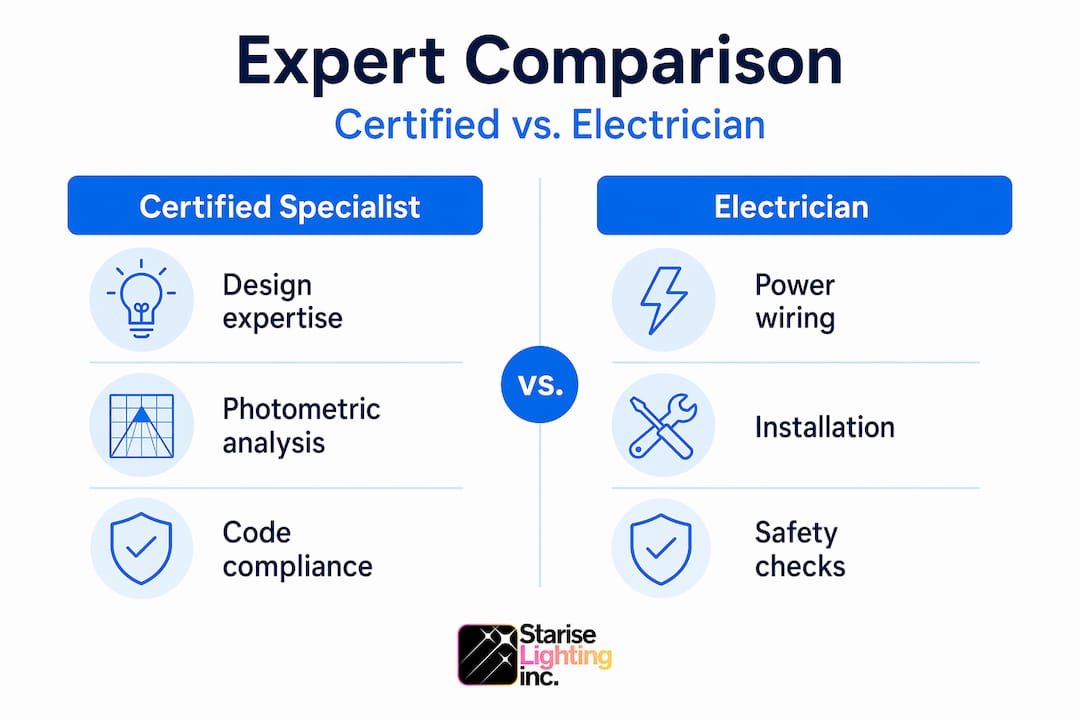
| Approach | Strengths | Limitations |
|---|---|---|
| Certified lighting specialist | Design precision, code compliance, rebate access, long-term cost savings | Higher upfront professional fees |
| Licensed electrician | Safe installation, permitted wiring work | No photometric training, no design strategy |
| DIY or uncertified installer | Lower initial cost | Safety risks, non-compliance, poor aesthetics, no rebate eligibility |
The financial case for certified expertise is real. Certified designers prevent over-lighting by selecting appropriate beam angles and optics, reducing costs and glare at the same time. Fewer fixtures installed correctly outperforms many fixtures installed arbitrarily.
The benefits of hiring lighting specialists extend to rebate access as well. Certified lighting professionals help navigate complex local ordinances and maximise access to utility incentive programmes through energy-efficient designs. DLC QPL-listed fixtures, for example, are used by 70% of utility rebate programmes across North America. Without a specialist who knows how to specify those products correctly, you leave real money unclaimed.
Amateur installations also carry risks that are not always visible immediately. Fixtures positioned to create glare on a public road can violate municipal bylaws. Wiring that bypasses proper weatherproofing fails within a season in harsh climates like Calgary's. Non-compliant installations may void your home insurance coverage in the event of a claim. Those consequences accumulate long after the initial cost saving from skipping a professional looks appealing.
For a clear picture of how professional installations compare to doing it yourself, the Starise vs DIY comparison lays out the real differences in outcome and long-term value.
How lighting specialists strengthen home security
Security lighting is one area where the gap between a specialist's approach and a generic installation becomes most visible. A certified lighting expert does not simply add bright lights. They design a system that deters crime, guides safe movement, and avoids creating new problems in the process.
Key elements of specialist-driven security lighting design include:
- Eliminating dark zones without over-illuminating: Criminals use shadow to their advantage. A well-designed system removes those shadows at entrances, garage areas, and side yards without flooding adjacent properties with unwanted light.
- Glare control: Excessive brightness at the wrong angle creates glare that actually reduces visibility and can irritate neighbours. Specialists select fixtures and beam angles that integrate smart controls and sensor strategies to manage intensity and direction precisely.
- Smart lighting integration: Motion sensors, programmable schedules, and app-based controls add a layer of active security that static lighting cannot match. Specialists spec these systems so they work together rather than conflicting.
- Meeting HOA and municipal standards: Many areas have specific requirements for security lighting levels and light trespass limits. Certified lighting consultants understand these rules and design accordingly, protecting you from fines or mandatory rework.
- Pathway and entry safety: Well-lit pathways reduce trip hazards and support safe movement for residents and visitors. This is especially relevant in climates where ice and snow obscure ground hazards.
Pro Tip: When discussing security lighting with a specialist, ask them to identify your property's shadow zones using a scaled site plan. That conversation alone will reveal whether you are dealing with a genuine expert or someone making general recommendations.
The advantages of exterior lighting for your home go well beyond aesthetics when a trained professional designs the system with security as a primary objective.
How to work with a certified lighting specialist
Knowing what specialists do is one thing. Knowing how to engage one effectively is where homeowners and developers often stumble. A structured approach saves time, money, and misunderstandings.
-
Verify credentials before anything else. Check the NCQLP registry for LC holders or request documentation of COLD or CEM certification directly. Do not accept a description of experience as a substitute for verifiable credentials.
-
Prepare for the initial consultation. Bring a site plan or property sketch, photos of your current exterior, and a clear list of priorities. Security, curb appeal, and energy efficiency may all matter to you, but knowing which comes first helps the specialist allocate design attention appropriately.
-
Clarify deliverables in writing. A professional engagement should produce a photometric report, a fixture schedule, a lighting layout drawing, and compliance documentation. If a consultant cannot describe these deliverables clearly, that is a problem.
-
Understand the permit process. Most exterior lighting installations in Canadian municipalities require permits, particularly when new circuits are involved. Your specialist should coordinate with your electrician to handle this correctly, not leave it as your problem to sort out.
-
Think in terms of lifecycle cost, not just installation cost. A well-designed system with permanent outdoor LED lighting pays for itself through reduced energy bills, lower maintenance demands, and avoided rework. Budget conversations that focus only on upfront cost miss the more important number.
-
Ask about rebate eligibility. Before finalising fixture specifications, ask your specialist which products qualify for local utility rebates and what documentation you will need to submit the claim.
My take on what homeowners consistently get wrong
I've seen the same pattern repeat with homeowners across countless exterior lighting projects. They call an electrician, describe what they want in general terms, approve a fixture list that looks good in product photos, and expect the results to match their vision. They rarely do.
The assumption that electrical skill equals lighting design skill is the most expensive misconception in exterior home upgrades. These are genuinely different disciplines. An electrician who is excellent at their work is not trained to read a photometric study, calculate uniformity ratios, or spec a beam angle that keeps light off your neighbour's bedroom window.
What I've learnt from working in this space is that the homeowners who get the best outcomes treat the specialist consultation as the foundation, not an optional add-on. They come in with questions, push for photometric data, and treat the design phase as seriously as they would a structural engineering review. The ones who skip that step often come back looking for help fixing a system that cost more to install than a professional design would have.
Strategic lighting also does something that most homeowners underestimate: it reduces fixture counts. The reflex is to assume more lights means better coverage. Specialists know that fewer, correctly placed fixtures almost always outperform a larger number of poorly positioned ones. That means lower material cost, lower energy consumption, and a cleaner aesthetic.
My honest advice is to prioritise the consultation. The upfront investment is modest relative to what a redesign costs after the fact.
— Starise
Permanent exterior lighting done right in Calgary and Edmonton
Co-starise brings certified lighting expertise to permanent exterior installations across Calgary and Edmonton. The systems Co-starise installs use Gen 2 24V LED technology built to withstand Alberta's winters, and every installation is designed with curb appeal, security, and energy performance in mind. Rather than a seasonal setup you store and reinstall, Co-starise delivers a permanent lighting solution that works nightly without maintenance headaches. If you are in Edmonton, the team also serves your area with the same standard of design and installation quality through permanent lights in Edmonton. Reach out for a consultation and get a design that reflects genuine expertise rather than guesswork.
FAQ
What does a certified lighting specialist do?
A certified lighting specialist designs exterior and interior lighting systems using photometric analysis software, ensures compliance with energy codes and safety standards, and coordinates with other trades to deliver precise, efficient, and aesthetically sound results.
How do lighting specialists differ from electricians?
Electricians handle power delivery and safe installation, while lighting specialists provide strategic design, photometric data, fixture specification, and compliance documentation. You need both for a complete and high-quality exterior lighting project.
Why does certification matter when hiring a lighting professional?
Certifications like COLD and LC confirm that a specialist has passed rigorous exams, met experience requirements, and commits to continuing education. That baseline guarantees a level of technical knowledge that uncertified installers cannot offer.
Can a certified specialist help me access utility rebates?
Yes. Certified lighting professionals understand which products qualify under programmes tied to standards like DLC QPL, and they produce the compliance documentation utilities require to process rebate claims.
How do lighting specialists improve home security?
Specialists eliminate shadow zones, control glare, and integrate smart sensor systems to deter crime and support safe movement without creating light trespass issues for neighbours or violating local bylaws.