

TL;DR:
- Long lasting LED technology provides high lumen output for 25,000 to 100,000 hours, significantly exceeding incandescent bulbs.
- Proper thermal management, quality drivers, and environment matching are essential for maximizing LED lifespan and performance.
Long lasting LED technology is defined as solid-state lighting that maintains high lumen output and operational efficiency for 25,000 to 100,000 hours, far exceeding the roughly 1,000-hour lifespan of incandescent bulbs. The industry standard term for this performance category is high-lumen-maintenance LED lighting, measured against benchmarks like L70 and L80. Quality LEDs use at least 75% less energy than incandescent alternatives while lasting up to 25 times longer. For homeowners and property developers in Calgary and across Canada, that gap translates directly into lower utility bills, fewer replacements, and a more durable exterior lighting investment.
What is long lasting LED technology and how does it work?
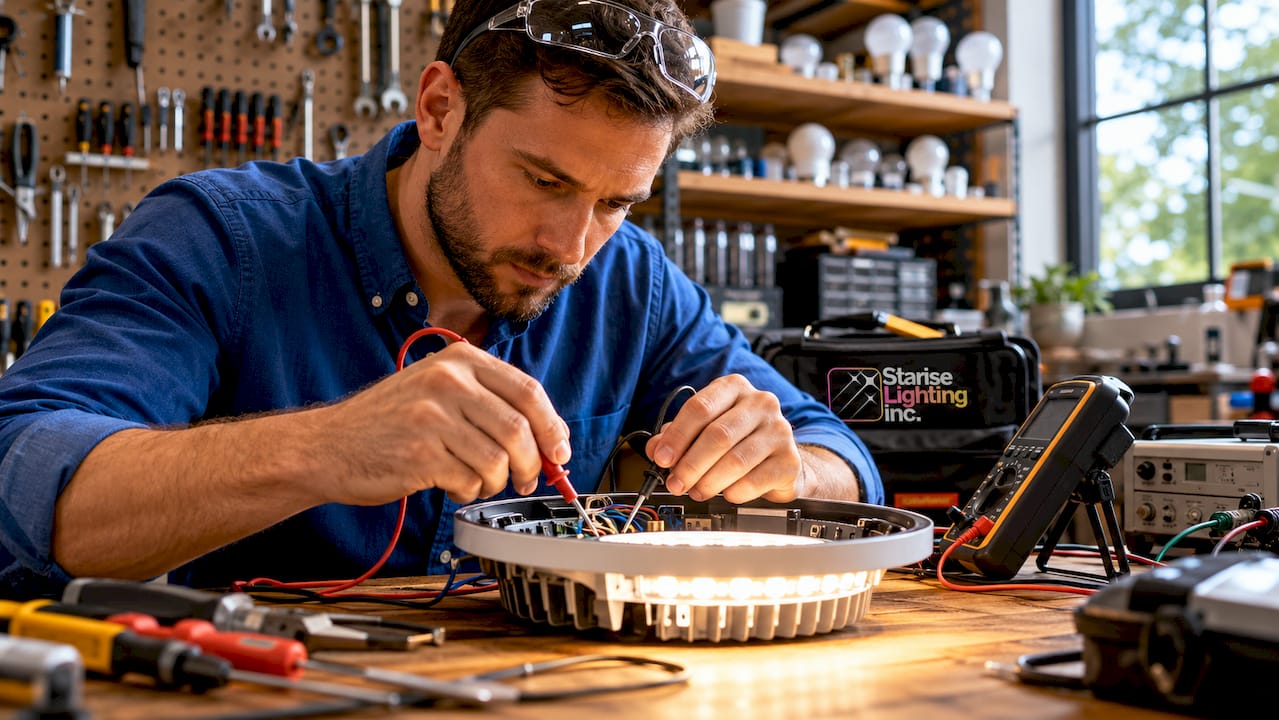
Long lasting LED technology achieves its extended lifespan through semiconductor-based light production rather than burning a filament or exciting a gas. When electrical current passes through a diode, it emits photons directly. There is no fragile filament to snap and no glass envelope to shatter. The result is a light source that degrades gradually rather than failing without warning.
The industry measures this gradual decline using lumen maintenance standards. L70 is the most common benchmark, meaning the rated lifespan is the point at which output drops to 70% of its original brightness. L80 and L90 ratings indicate even stricter performance thresholds, used in high-demand or commercial applications. Understanding these numbers helps you compare products honestly rather than relying on marketing claims alone.
Three core components determine how long a quality LED system actually lasts:
- LED chips: The semiconductor diodes themselves are highly durable when operated within their rated temperature and current range.
- Drivers: These convert AC power to the DC current LEDs require. Driver failure is the most common cause of LED system failure, not chip degradation. Voltage spikes, poor heat dissipation, and low-quality manufacturing all shorten driver life.
- Thermal management: Heat is the primary enemy of LED longevity. Heat accumulation can halve LED lifespan or worse, particularly when bulbs rated for open-air use are installed inside enclosed fixtures without ventilation.
Pro Tip: When shopping for outdoor LED fixtures in Calgary, check the fixture's IP rating and confirm the LED is rated for enclosed or wet locations. A bulb rated for free-air use installed inside a sealed housing will fail far sooner than its label suggests.
Common misconceptions about LED lifespan
The biggest misconception homeowners carry is that a rated lifespan is a guarantee. It is not. Rated lifespan is a statistical estimate based on controlled laboratory conditions, meaning a percentage of units in a batch will fall short of that number under real-world conditions. Temperature swings, humidity, and installation quality all shift the outcome.
A second misunderstanding is conflating chip life with system life. The LED chip itself may still function at L70 after 50,000 hours, but the driver powering it could fail at 20,000 hours due to a single electrical surge. This distinction matters when you are evaluating a product's total value.
Smart LEDs add another layer of complexity. Bulbs with integrated Wi-Fi or Bluetooth modules contain additional electronic components, each with its own failure rate. The convenience of app control comes with a trade-off in component count. That does not make smart LEDs a poor choice, but it does mean the weakest link in the system determines the effective lifespan.
Here is what to look for when evaluating product reliability:
- ENERGY STAR certification: ENERGY STAR-certified LEDs with published lumen maintenance data and a minimum three-year warranty are significantly more likely to reach their rated lifespan.
- LM-80 test data: This standardised test measures lumen depreciation over time and is the foundation for any credible lifespan claim.
- Driver B10 ratings: Driver B10 ratings and thermal design integration are the most reliable predictors of long-term LED performance.
Pro Tip: Ask your lighting supplier for the LM-80 test report before purchasing fixtures for a major renovation or new build. Any reputable manufacturer will provide it without hesitation.
How do LEDs compare to incandescent and CFL lighting?
The performance gap between LED technology and older lighting types is not marginal. It is structural. The table below summarises the key differences for residential use.
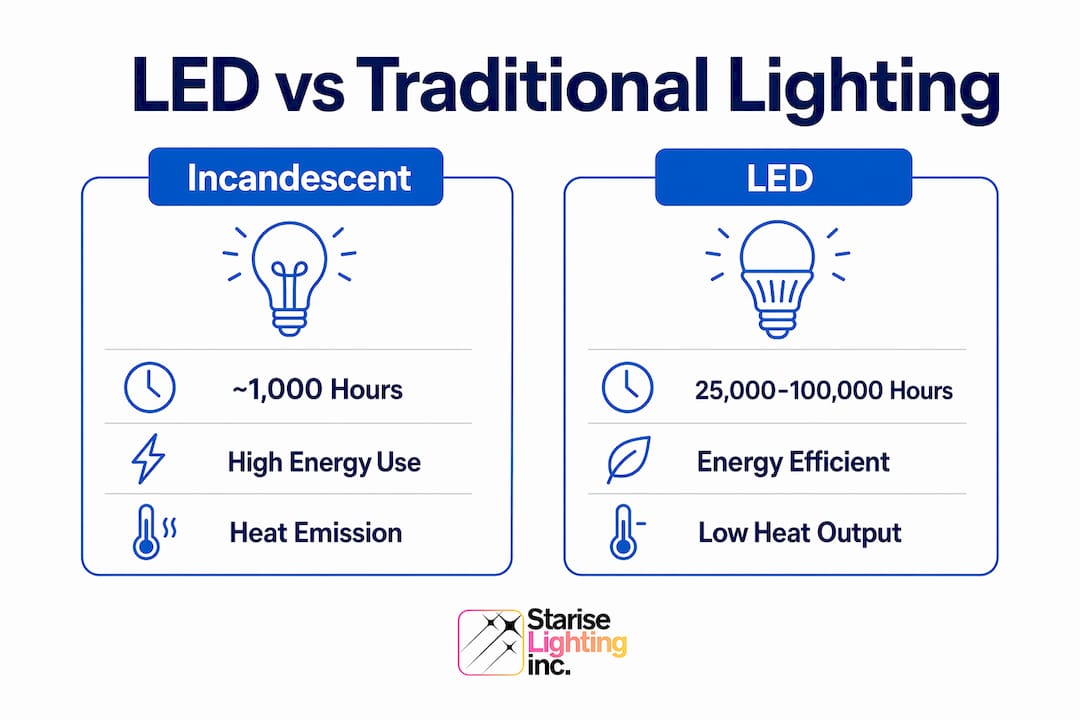
| Feature | Incandescent | CFL | LED |
|---|---|---|---|
| Typical lifespan | ~1,000 hours | ~8,000–10,000 hours | 25,000–100,000 hours |
| Energy use vs. LED | ~4x more | ~1.5x more | Baseline |
| Heat output | Very high (90% as heat) | Moderate | Very low |
| Durability | Fragile glass | Fragile glass, mercury | Epoxy lens, solid-state |
| Warm-up time | Instant | Slow (30–60 seconds) | Instant |
| Dimming compatibility | Universal | Limited | Widely compatible |
LEDs produce up to 90% of their energy as light, while incandescents lose 90% as heat. That thermal difference is not just an efficiency story. Lower heat output means less stress on every component in the fixture, which directly extends the system's operational life. For a property developer fitting out 40 exterior fixtures on a new build, that difference compounds into significant savings on both energy and maintenance over a 10-year horizon.
CFLs were a meaningful improvement over incandescents, but they contain mercury, require careful disposal, and degrade faster in cold temperatures. In Calgary's winters, CFL performance drops noticeably. LEDs, by contrast, often perform better in cold conditions, making them the clear choice for outdoor residential lighting in Alberta's climate.
How to choose and install long lasting LED lighting for your home
Selecting the right LED product is half the battle. Installation quality determines whether that product reaches its rated lifespan or falls short. Follow these steps to get the most from your investment.
-
Match the LED to the fixture environment. Confirm whether your fixture is open, enclosed, or wet-rated. Use only LEDs labelled for that specific environment. Mismatched installations are the leading cause of premature failure in residential settings.
-
Prioritise transparent lumen maintenance data. Choose products that publish L70 or L80 ratings alongside LM-80 test results. A product that only states "50,000 hours" without specifying the lumen maintenance standard is making an incomplete claim.
-
Check dimmer compatibility before purchasing. Incompatible dimmers cause flickering, buzzing, and accelerated driver wear. Confirm the LED driver is rated for the specific dimmer model in your home. The Lutron and Leviton compatibility databases are reliable references for this check.
-
Consider modular and serviceable fixtures. Circular lighting design emphasises serviceability and reparability, extending fixture life beyond the rated LED chip life. A fixture where you can replace the driver board independently of the LED array costs more upfront but eliminates the need to replace the entire luminaire when one component fails. Signify and other manufacturers now offer luminaires engineered specifically for this approach.
-
Integrate smart controls where practical. Smart lighting systems with demand-based controls can autonomously reduce operating stress and prolong system lifespan. Dimming to 80% output during low-traffic hours, for example, meaningfully extends the time before an LED reaches its L70 threshold. Co-starise's Gen 2 24V system pairs with a user-friendly app that gives you this kind of precise control over your exterior lighting programme.
-
Account for ventilation in retrofit projects. When replacing older bulbs in existing fixtures, check that the housing allows adequate airflow. Adding a high-output LED to a sealed Victorian-style porch lantern without ventilation is a common and costly mistake.
Pro Tip: For permanent outdoor installations, prioritise fixtures with IP65 or higher ratings and look for systems that allow driver replacement without removing the entire fixture. This single decision can double the effective economic life of your lighting investment.
You can explore how energy savings compound over time with permanent outdoor LED systems to build a clearer picture of total cost of ownership before committing to a product line.
Key takeaways
Long lasting LED technology delivers its full value only when the right product is matched to the right fixture environment, backed by transparent lumen maintenance data and a credible warranty.
| Point | Details |
|---|---|
| Lifespan is a spectrum | Quality LEDs last 25,000 to 100,000 hours depending on chip quality, driver design, and thermal management. |
| Drivers fail first | LED chip degradation is rarely the cause of failure. Driver quality and heat management determine real-world lifespan. |
| Ratings need context | L70, L80, and LM-80 data tell you far more than a bare hour count on the packaging. |
| Installation matters as much as product | Placing a free-air LED in an enclosed fixture without ventilation can cut its lifespan in half or worse. |
| Modular design extends value | Serviceable fixtures that allow driver or board replacement reduce total cost of ownership and waste over time. |
Why I think most homeowners are buying LEDs wrong
After working with residential lighting across Calgary, the pattern I see most often is homeowners optimising for the wrong variable. They compare rated hours on the box and buy the highest number at the lowest price. That logic misses the point entirely.
The real question is not how long the chip is rated to last. It is whether the driver, the fixture, and the installation environment will allow the chip to reach that rating. A 50,000-hour LED in a poorly ventilated enclosed fixture, running on a cheap driver with no surge protection, will not outlast a well-installed 25,000-hour product in a properly rated housing.
I have also seen homeowners dismiss modular fixtures as unnecessary complexity. The opposite is true. A fixture where you can swap the driver for $30 rather than replacing a $200 luminaire is not complicated. It is sensible engineering. The shift toward circular lighting principles in the industry reflects this thinking, and it is the direction that genuinely sustainable lighting solutions are heading.
The other overlooked factor is curb appeal longevity. Lighting that dims noticeably over three years does not just cost you in energy terms. It changes how your home looks at night, which affects both your enjoyment and your property's perceived value. Choosing products with L80 or L90 ratings rather than the standard L70 means the light you see in year five looks much closer to what you installed on day one. That is worth paying for. You can see how durable lighting affects curb appeal in practice to understand why this matters beyond the technical specs.
— Starise
Permanent LED lighting built to last from Co-starise
Co-starise designs permanent outdoor lighting systems for Calgary homeowners who want to install once and stop thinking about replacements. The Gen 2 24V LED technology at the core of every Co-starise installation is engineered for Alberta's climate extremes, with weatherproof construction, modular serviceability, and a full app-based control programme that lets you manage colour, brightness, and scheduling from your phone.
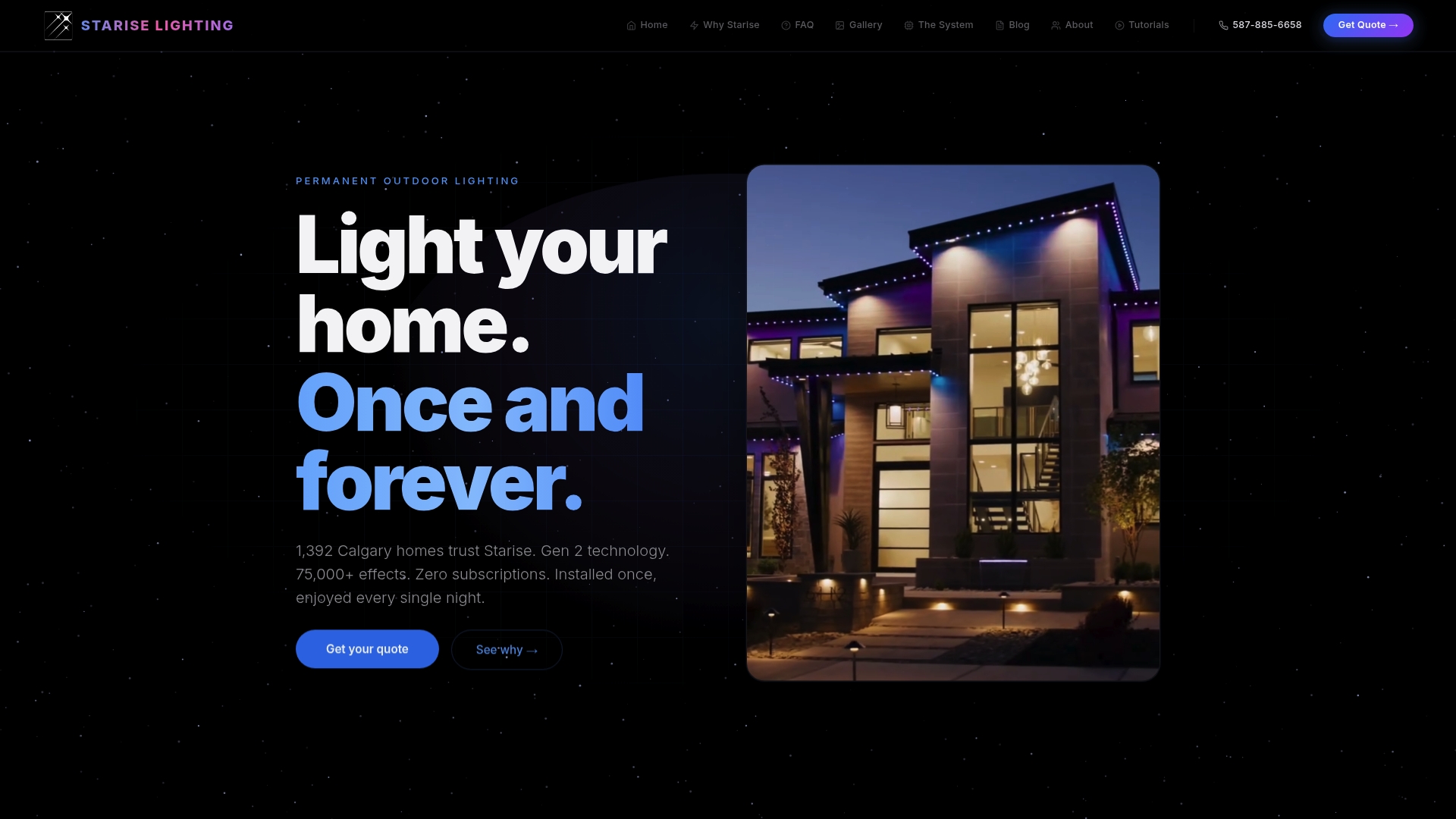
Every system is built around the principles covered in this article: quality drivers, proper thermal management, and fixtures designed for long-term performance rather than short-term cost savings. If you are ready to explore a permanent lighting solution that delivers real durability and energy efficiency, Co-starise offers personalised quotes for residential and development projects across Calgary and surrounding areas.
FAQ
How long do LEDs last in real-world conditions?
Quality residential LEDs last between 25,000 and 50,000 hours under normal conditions, with high-end fixtures reaching 100,000 hours. Real-world lifespan depends heavily on installation environment, driver quality, and thermal management.
What does L70 mean on an LED product?
L70 is the point at which an LED's output drops to 70% of its original brightness, and it defines the rated lifespan for most residential products. L80 and L90 ratings indicate higher lumen maintenance thresholds used in more demanding applications.
Why do LED lights fail before their rated lifespan?
Driver failure is the most common cause of premature LED failure, typically triggered by heat accumulation, voltage spikes, or low-quality manufacturing. Installing a free-air LED inside an enclosed fixture without ventilation is the single most common installation mistake that shortens lifespan.
Are ENERGY STAR-certified LEDs worth the extra cost?
Yes. ENERGY STAR-certified products with published lumen maintenance data and a minimum three-year warranty are reliably more likely to reach their rated lifespan than uncertified alternatives. The certification process requires independent testing that most budget products never undergo.
Do smart LEDs last as long as standard LEDs?
Smart LEDs contain additional electronic components for wireless connectivity, which introduces more potential failure points than a standard LED driver alone. They can still achieve long lifespans, but the effective lifespan of the system depends on the weakest component, which is often the wireless module rather than the LED chip itself.