
TL;DR:
- LED "lifetime" refers to gradual lumen depreciation, not an abrupt fixture failure, with performance influenced by heat, installation quality, and maintenance. Different lumen maintenance thresholds (L70, L80, L90) determine how much light diminishes over time, impacting home aesthetics and security; modular systems enhance sustainability and ease upgrades. Proper heat management and choosing high-quality components are essential for maximizing LED longevity and ensuring long-term value.
Spend five minutes reading LED packaging and you will find claims like "50,000 hours" printed proudly on the box. Most homeowners read that number and picture a bulb that simply keeps working for decades without a second thought. That is not quite how it works. What is lifetime LED lighting, really? The honest answer is that LED "lifetime" describes a gradual dimming process governed by industry metrics, not a hard stop where your light suddenly quits. Understanding what those figures actually mean lets you shop smarter, protect your home's curb appeal, and get genuine long-term value from every fixture you install.
Table of Contents
- Key takeaways
- Understanding LED lifetime metrics: L70, L80, and L90
- Real-world factors that shorten LED lifespan
- How LED lifetime affects aesthetics, energy use, and security
- Modular LED systems and sustainable solutions
- How to choose quality lifetime LED lighting
- My perspective on what homeowners get wrong
- Why Co-starise permanent lighting delivers on lifetime
- FAQ
Key takeaways
| Point | Details |
|---|---|
| "Lifetime" means dimming, not death | LED lifetime refers to lumen depreciation reaching a set threshold, not sudden failure. |
| Metrics vary and matter | L70, L80, and L90 ratings are not interchangeable; the number you compare must match. |
| Heat is the biggest enemy | A 10°C rise in junction temperature can cut rated lifespan in half. |
| Installation quality is half the equation | Even premium LEDs underperform when housed in poorly ventilated or cheaply made fixtures. |
| Modular systems extend overall fixture life | Replaceable light engine technology lets you renew a fixture without removing the whole fitting. |
Understanding LED lifetime metrics: L70, L80, and L90
If you have ever wondered why one brand's "50,000 hours" claim feels different from another's, the reason is almost always the lumen maintenance level attached to that number. LED lifetime claims refer to the point at which light output drops to a specified percentage of its original brightness, not the point at which the fixture stops working entirely.
Here is how the three main thresholds break down:
- L70 means the fixture still produces 70% of its original lumen output at the stated hour mark. This is the most widely quoted standard and the one you will see most often on residential packaging.
- L80 means 80% of original brightness remains. This is a stricter benchmark used in applications where light quality matters more, such as retail displays or security lighting.
- L90 means 90% of original brightness remains. Rarely claimed on mass-market products, this threshold is reserved for precision or high-end commercial applications.
The critical issue is that a 50,000-hour figure can correspond to L70, L80, or L90, which means the actual light output at that milestone differs by 10% to 30% depending on which standard was used. Two products with identical hour claims can perform very differently in your home if they are measuring to different thresholds.
These numbers come from testing. Manufacturers submit LED components for LM-80 testing and use the results under the IES TM-21 methodology to project how lumen output will change over time. The key word is "project." Real-world stresses like heat, voltage fluctuation, and moisture can cause actual performance to diverge from those projections.
Pro Tip: When comparing products, always ask or check the spec sheet for which lumen maintenance level corresponds to the quoted hours. An L80 rating at 50,000 hours is meaningfully better than an L70 rating at the same hour count.
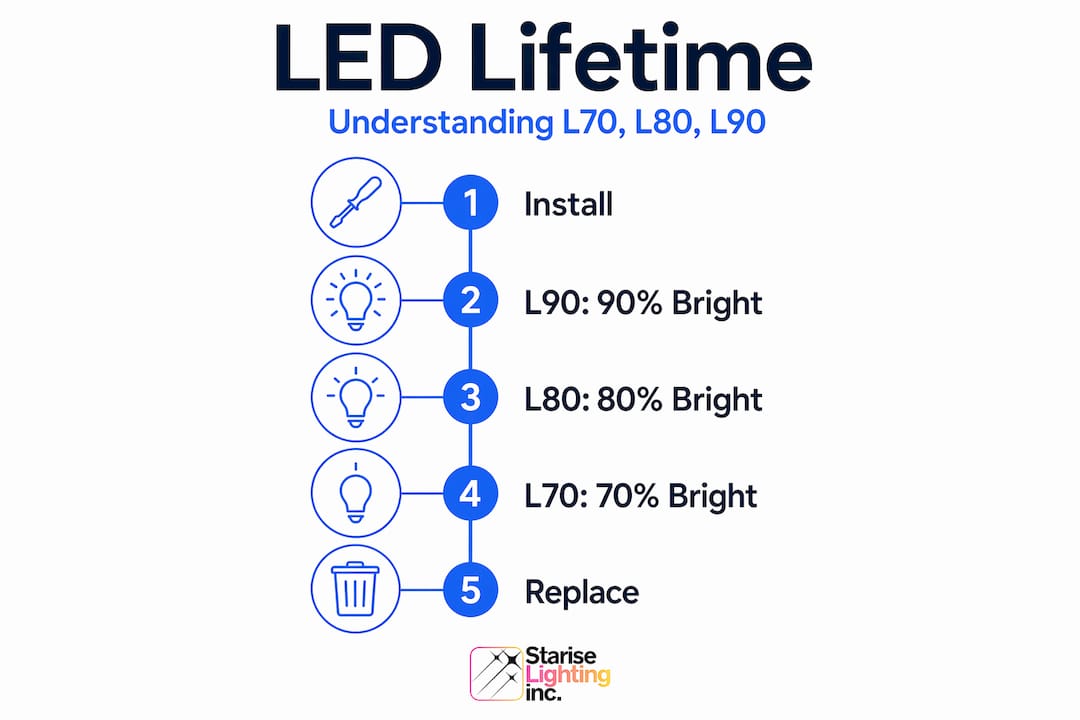
| Threshold | Light output remaining | Typical use case |
|---|---|---|
| L70 | 70% | General residential and outdoor lighting |
| L80 | 80% | Security lighting, retail, accent lighting |
| L90 | 90% | High-precision commercial or display applications |
Real-world factors that shorten LED lifespan
Knowing the rated hours is only half the story. The gap between what a spec sheet promises and what actually happens in your home is almost always explained by one of four variables.
Heat is the dominant factor. A 10°C increase in junction temperature can halve the rated lifespan of an LED. An LED rated for 50,000 hours at 65°C may only deliver 25,000 hours if its operating temperature climbs to 85°C. This is not a gradual, linear decline. It is exponential, which means small temperature increases compound into large lifespan reductions very quickly.
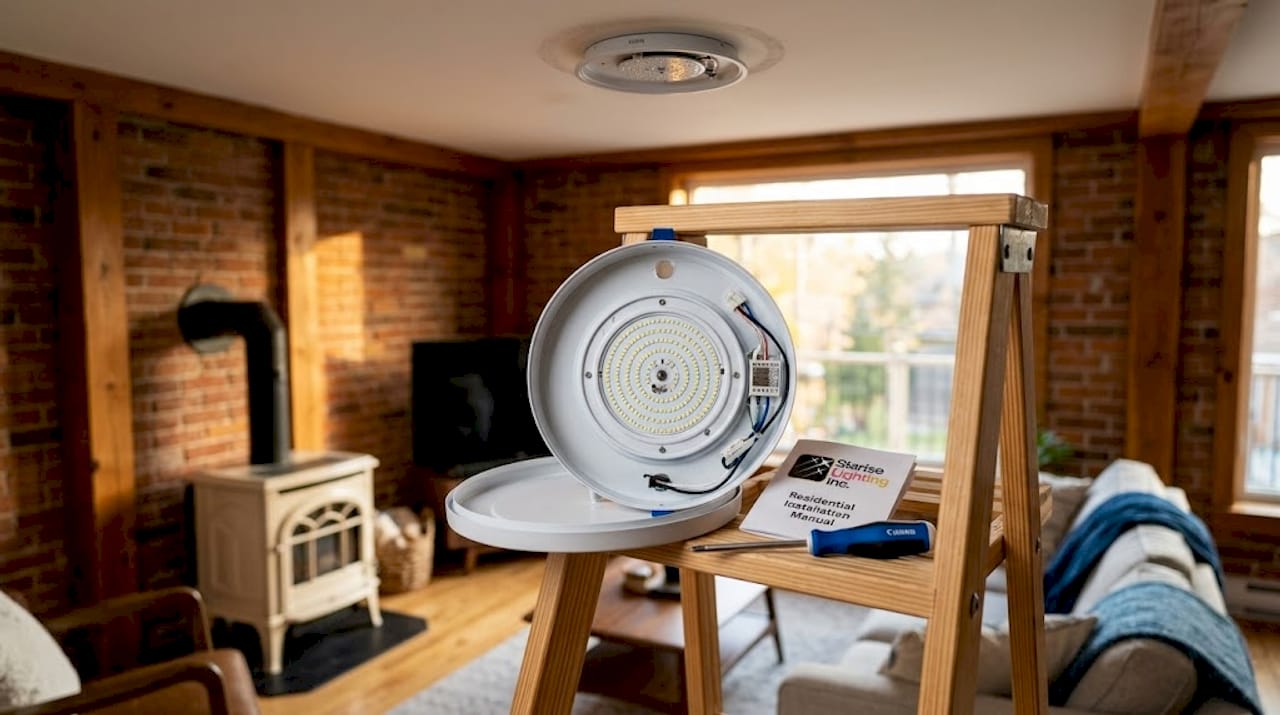
Fixture design and ventilation matter enormously. A high-quality LED chip inside a poorly ventilated housing is still a poorly performing product. Poor heat dissipation, dust accumulation, and voltage instability are the most common practical causes of shortened LED life. For Calgary homeowners, this is especially relevant. Outdoor fixtures need to handle freeze-thaw cycles, snow accumulation, and wind-driven debris, all of which affect ventilation and heat management.
Driver quality determines system reliability. Drivers regulate power to the LED array, and exposure to power spikes or unstable voltage can cause driver failure even when the LED chips themselves are still healthy. In many cases, the driver is the component that fails first. Choosing fixtures with quality-rated drivers is as important as choosing quality LEDs.
Dust, dirt, and lack of maintenance accumulate over time. Outdoors, lenses and housings collect grime that reduces light output independently of lumen depreciation. A dirty fixture can lose 10% to 20% of its effective output from soiling alone, well before the LEDs themselves approach their rated threshold.
Pro Tip: For exterior applications, look for fixtures rated IP65 or higher. That rating confirms the housing is sealed against dust and water jets, which directly protects both the LEDs and the driver from the elements.
How LED lifetime affects aesthetics, energy use, and security
The practical consequences of lumen depreciation play out differently across three areas that matter most to homeowners: how your home looks, how much you spend on electricity, and how safe your property feels at night.
-
Curb appeal and ambience. Gradual dimming is the key phrase here. You will not notice your outdoor LEDs fading from week to week, but over several years the difference in brightness becomes visible. A fixture that was crisp and vibrant at installation can look dull and underwhelming at the L70 threshold. For homeowners who invest in permanent outdoor lighting to boost curb appeal, this timeline should factor into your planning from the start.
-
Security effectiveness. Security lighting depends on adequate illumination levels. Fixtures continue working below L70, but homeowners must judge whether that dimming compromises the purpose of the light. A pathway that needs 50 lux to feel safe at night may fall below that threshold well before the fixture technically "fails." Planning replacements or upgrades around L80 or even L70 milestones rather than waiting for burnout is the smarter approach.
-
Energy savings over time. LEDs offer substantial long-term savings compared to incandescents and halogens, and that remains true even as lumen output gradually declines. The energy draw of an LED stays roughly constant even as it dims, which means your electricity savings hold up well over the fixture's life. The tradeoff is that you are eventually paying the same power bill for less light, which is why monitoring output and planning timely upgrades matters for both efficiency and safety.
-
Planning cycles for upgrades. Rather than waiting for a fixture to fail, treat the L70 or L80 milestone as a planned maintenance event. This gives you control over your home's lighting appearance and security coverage, instead of being caught with a dim or failed fixture at an inconvenient time.
Modular LED systems and sustainable solutions
One of the more promising developments in residential lighting is the move toward modular, replaceable light engine systems. The core idea is straightforward. Instead of discarding an entire fixture when the LEDs reach their rated lifetime, you replace only the light engine inside it.
The Linmore LifeTime Series is a well-known example, featuring a ReLuma module that allows a tool-free swap of the LED array. The fixture housing, driver wiring, and mounting hardware stay in place. Only the light-producing component is renewed. This approach has clear advantages:
- Reduced waste. The majority of the fixture's material, including housing, reflectors, and wiring, does not end up in a landfill when LEDs reach their limit.
- Lower replacement cost. Swapping a module costs significantly less than purchasing and installing a full new fixture.
- Extended system life. The overall installation can last many decades, with periodic module renewals keeping light output fresh.
- Consistency of appearance. Because the housing stays the same, your home's exterior lighting maintains a uniform look over time.
The market is moving in this direction because sustainability expectations are rising and homeowners are becoming more aware of the long-term costs embedded in permanent lighting installations. For those exploring home lighting system comparisons, modular systems increasingly stand out as the longer-term value proposition.
How to choose quality lifetime LED lighting
Armed with an understanding of metrics and real-world factors, you can approach any purchase with clear questions that cut through marketing language.
- Ask the manufacturer or supplier which lumen maintenance threshold corresponds to their quoted lifetime hours. L70, L80, and L90 are not equivalent.
- Check whether the product has LM-80 test data and whether the manufacturer uses IES TM-21 methodology to project rated hours. Products without this validation are making unsubstantiated claims.
- Review the fixture's IP rating for outdoor use. For Canadian winters, IP65 is a minimum; IP67 or higher is better for ground-level or exposed installations.
- Examine the warranty. A quality LED system should carry a warranty of at least five years on both the LEDs and the driver. Short warranties on premium-priced products are a warning sign.
- Ask about driver quality specifically. Many manufacturers will specify the driver brand or provide its rated hours separately from the LED hours.
Pro Tip: The LED lighting lifespan quoted by a manufacturer is a projection under test conditions. Ask how the fixture manages heat in real-world installations. A supplier who can answer that question confidently is one who understands their product.
Maintenance also extends life meaningfully. Clean outdoor fixture lenses twice a year to prevent soiling losses. Check that ventilation gaps on housings are not blocked by debris or ice. And treat the first sign of flickering as a driver issue worth addressing promptly, before it cascades into LED degradation.
My perspective on what homeowners get wrong
I have spoken with many homeowners who felt misled after buying LEDs based on a "50,000-hour" claim. In almost every case, the disconnect was not dishonesty from the manufacturer. It was a genuine misalignment between what that number means technically and what the homeowner expected it to mean practically.
The word "lifetime" carries an emotional weight that the industry has not been careful about. People hear it and think permanence. Engineers mean it as a measured depreciation milestone. That gap in translation causes real frustration and real money spent on premature replacements.
What I have found is that the thermal management story is the one most worth telling to homeowners, and it is the one that almost never gets told at the point of sale. A fixture's ability to move heat away from the LED junction is the single biggest determinant of whether you get 25,000 or 50,000 hours out of a product. This is far more influenced by installation quality than most buyers realise.
The modular light engine direction genuinely excites me because it reframes the conversation. Instead of asking "how long will this last," you ask "how easy is it to renew." That is a healthier and more honest relationship with any long-term home investment.
— Starise
Why Co-starise permanent lighting delivers on lifetime
If you are weighing a permanent LED lighting investment for your Calgary home, the lifetime question is exactly the right place to start.
Co-starise builds its permanent LED lighting systems around Gen 2 24V technology designed for Calgary's demanding climate, where freeze-thaw cycles and heavy snowfall test fixtures that most southern Canadian products never face. Every installation uses weatherproof construction, quality-rated drivers, and components selected with long-term lumen maintenance in mind. The result is exterior lighting that holds its brightness, security function, and visual appeal over years of daily use. Co-starise also supports homeowners with ongoing guidance on maintenance and performance expectations. You can explore the full system to see exactly what goes into each installation before you commit.
FAQ
What does "lifetime" mean in LED lighting?
LED lifetime refers to the point at which light output drops to a specified percentage of original brightness, typically 70% (L70), not the point at which the light stops working entirely. LEDs dim gradually rather than burning out suddenly.
How long do LEDs last in real-world home use?
Most quality residential LEDs are rated for 25,000 to 50,000 hours at L70, but real-world lifespan depends heavily on heat management, driver quality, and installation conditions. Poor ventilation or voltage instability can reduce that figure significantly.
What is the difference between L70, L80, and L90?
These thresholds describe how much original brightness remains at the rated hour mark. L70 means 70% remains, L80 means 80%, and L90 means 90%. Comparing hour claims without knowing which threshold was used can be misleading.
Why does heat affect LED lifespan so much?
Heat raises the junction temperature inside the LED chip, and each 10°C increase can halve the rated lifespan. This is why fixture design, ventilation, and ambient operating conditions matter as much as the quality of the LED component itself.
Are modular or replaceable LED systems worth considering for homes?
Yes. Modular systems let you replace only the light engine when LEDs reach their rated threshold, extending the fixture's overall life and reducing waste. For permanent exterior installations, this approach offers a lower long-term cost than replacing full fixtures.