
TL;DR:
- Understanding exterior lumens is crucial because they measure the total light output, not how bright surfaces appear at ground level. Lux, which measures light received per square meter, better predicts real-world illumination, depending on mounting height and optics. Proper fixture placement, aiming, and analysis of photometric data ensure effective outdoor lighting for safety and aesthetics.
Most homeowners shop for outdoor fixtures by comparing watt ratings or assuming brighter always means better. The truth is, understanding exterior lumens is what separates a well-lit property from one that feels either blinding or frustratingly dim. Lumens measure the total light a fixture produces, but that number alone won't tell you how bright your pathway actually looks at night. This article breaks down what lumens really mean outdoors, how they translate to usable light on surfaces, and how to choose fixtures that deliver the safety and kerb appeal you're actually after.
Table of Contents
- Key takeaways
- What exterior lumens actually mean
- How light spreads outdoors
- Choosing the right lumens for each outdoor area
- Common mistakes homeowners make with lumens
- Applying lumen knowledge to your property
- My take on lumens and outdoor lighting
- Permanent exterior lighting that gets lumens right
- FAQ
Key takeaways
| Point | Details |
|---|---|
| Lumens measure output, not brightness | A fixture's lumen rating tells you how much light it produces, not how bright a surface will actually appear. |
| Lux is the number that matters on the ground | Lux measures light received per square metre and is the real indicator of how well an area is illuminated. |
| Mounting height changes everything | Doubling a fixture's mounting height reduces ground-level illuminance to roughly one quarter of its original value. |
| Beam angle and optics determine distribution | Two fixtures with identical lumen ratings can light your property very differently depending on their optics and aim. |
| LED longevity requires depreciation awareness | Lumen output in LED fixtures drops over time, so choosing fixtures rated for long-term maintenance matters for consistent performance. |
What exterior lumens actually mean
Exterior lumens refer to the total visible light emitted by an outdoor fixture, measured in lumens (lm). Think of it like water flowing from a tap. Lumens measure how much water flows. But what you actually care about is how deep the puddle gets in a specific spot, and that's where lux comes in.
Lux measures the light landing on a surface, where 1 lux equals 1 lumen per square metre. So the same lumen output can illuminate a small area brilliantly or spread thinly and dimly across a large yard. A 1,000 lumen fixture aimed at a two-square-metre front step delivers 500 lux per square metre. Spread that same output across 20 square metres, and you're left with just 50 lux. Same fixture. Completely different result.
Here's where most homeowners get tripped up:
- Lumens describe light output at the source
- Lux describes light received at the target surface
- Luminous intensity refers to how concentrated light is in a particular direction
- Beam angle controls how wide or narrow the light spreads once it leaves the fixture
Pro Tip: When comparing outdoor fixtures, ask for lux values at your specific mounting height rather than trusting lumen ratings alone. That's the number that predicts real-world performance at ground level.
Understanding exterior lumens means recognising that a high-lumen fixture aimed poorly or mounted too high can leave you with a disappointing result, while a modest-lumen fixture with well-designed optics can outperform it dramatically.
How light spreads outdoors
Outdoor lighting behaves very differently from indoor lighting, and the physics behind it explain why lumen ratings can mislead you. Outdoor lighting design uses point-by-point photometric calculations governed by the inverse-square law and cosine law, rather than the simpler lumen methods used for indoor rooms.
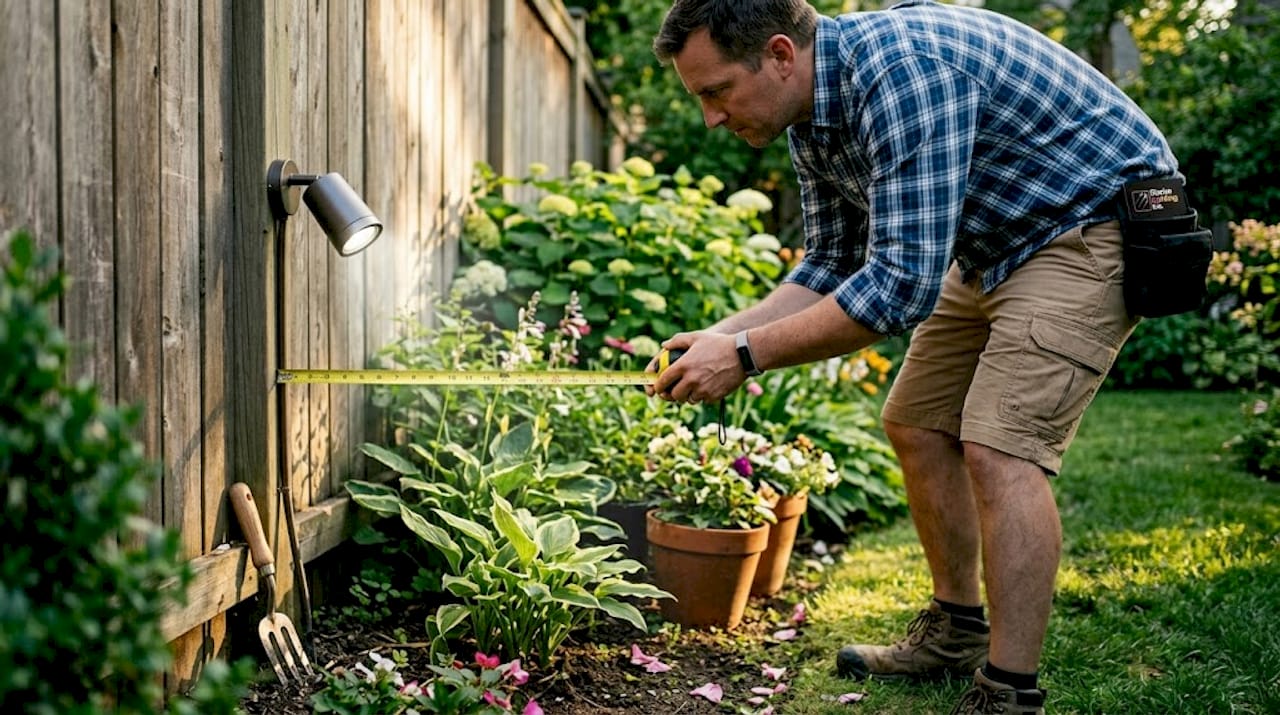
The inverse-square law is the key principle to understand. Mounting a light twice as high reduces ground-level illuminance to one quarter of what it was at the lower height. That's not a minor change. It's the difference between a well-lit walkway and a shadowy one, using the exact same fixture.
Here is how to think about outdoor light distribution when planning or upgrading your exterior lighting:
- Start with your target lux. Pathways typically need 50 to 100 lux. Entryways benefit from 100 to 200 lux. Security lighting often calls for 200 lux or more at the perimeter.
- Factor in mounting height. A wall-mounted fixture at 2.5 metres behaves very differently from the same fixture mounted at 5 metres, even with identical lumens.
- Account for beam angle. A narrow 15-degree beam concentrates light on a small area intensely. A 120-degree flood beam distributes it broadly but at lower intensity across each point.
- Consider fixture optics. Reflectors, lenses, and housing design shape how light exits the fixture and where it lands on your property.
- Think about aiming. A fixture aimed at the wrong angle creates hotspots directly below and deep shadows three metres away.
Pro Tip: Ask your lighting supplier for a photometric data sheet (also called an IES file) for any fixture you're considering. This file tells you exactly how light distributes from that specific product at various distances and angles, which is far more useful than a lumen number by itself.
LEDs emit light directionally, which is a significant advantage outdoors. Unlike omnidirectional incandescent bulbs that waste light in every direction, LEDs can be engineered to send light exactly where it's needed. This makes fixture placement and aiming far more precise, but it also means that getting the placement wrong has bigger consequences.
Choosing the right lumens for each outdoor area
Now that you understand the relationship between lumens and lux, here's a practical reference for what works in typical residential outdoor spaces.
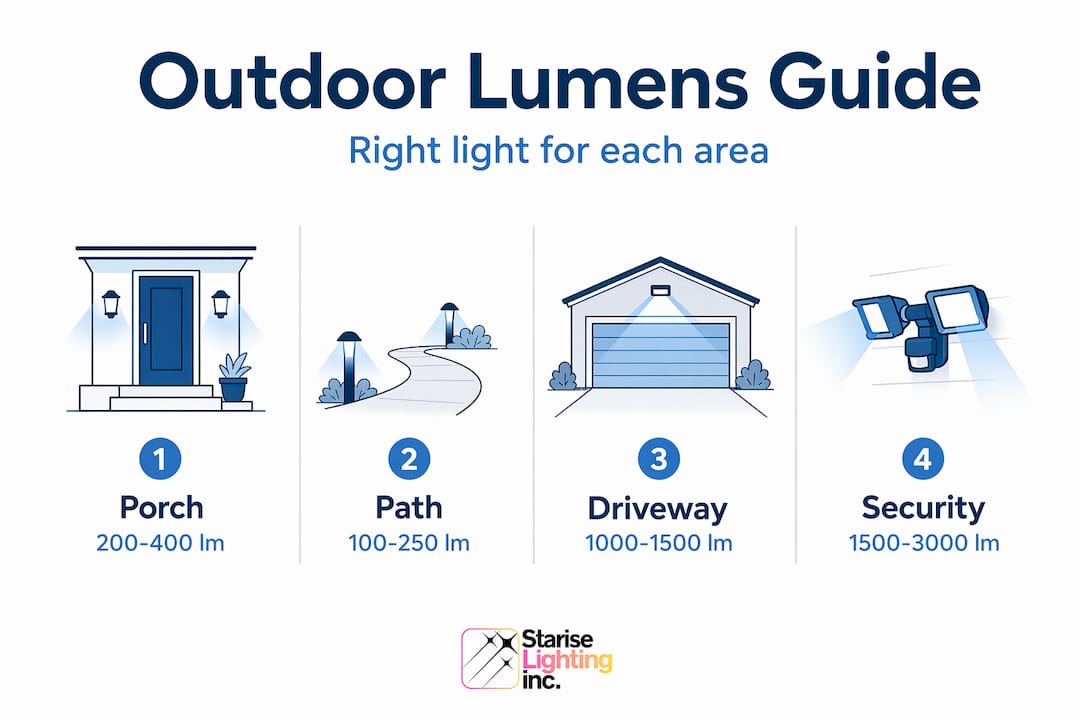
| Area | Recommended lumens | Target lux at surface | Colour temperature |
|---|---|---|---|
| Garden pathway | 100 to 200 lm per fixture | 50 to 100 lux | 2700K to 3000K (warm white) |
| Front entryway | 400 to 800 lm | 100 to 200 lux | 3000K to 3500K |
| Patio or deck | 600 to 1,200 lm total | 50 to 150 lux | 2700K to 3000K |
| Driveway | 1,000 to 2,000 lm | 50 to 100 lux | 3000K to 4000K |
| Security perimeter | 1,500 to 3,000 lm | 150 to 300 lux | 4000K (cool white) |
A few additional factors will sharpen your fixture selection beyond just lumen and lux targets:
- Colour temperature affects both safety and atmosphere. Warmer tones (2700K to 3000K) feel welcoming near entryways and patios. Cooler tones (4000K) improve visibility in security and driveway applications.
- Glare control matters more outdoors than indoors. A bare bulb with high lumens can be blinding at eye level. Shielded or frosted optics spread light more comfortably.
- Energy efficiency is a genuine long-term consideration. LED fixtures use at least 75% less energy than incandescent alternatives and can last up to 25 times longer, meaning fewer replacements and lower electricity bills year over year.
- Product lumen ratings on packaging reflect initial output under test conditions. Real-world performance depends on thermal management, driver quality, and installation conditions.
You can explore more about maximising LED energy savings when comparing exterior lighting options for your home.
Common mistakes homeowners make with lumens
Here's the uncomfortable reality: most outdoor lighting complaints are not caused by choosing the wrong lumen number. They're caused by misunderstanding how lumens behave once a fixture is installed. Recognising these pitfalls can save you significant frustration and cost.
-
Chasing high lumen numbers. A fixture rated at 3,000 lumens mounted 6 metres high on a wall can deliver disappointing ground-level brightness, while a 1,200 lumen fixture mounted at 2.5 metres with controlled optics lights your entryway beautifully. Lumens at the source don't guarantee illuminance at the surface.
-
Ignoring beam angle. A 5-degree spotlight and a 100-degree floodlight can share the same lumen rating, but produce completely different results. Proper optics and aiming create uniform lux distribution and reduce glare. Many homeowners choose a floodlight for a specific accent and wonder why the result looks washed out.
-
Overlooking lumen depreciation. LED output doesn't stay constant forever. Lumen maintenance standards like IES LM-80 and TM-21 project how much output a fixture retains over time. A cheap fixture may start at 1,000 lumens and drop to 600 within a few years, falling well below your original lighting target without any visible failure.
-
Underestimating mounting height effects. This one catches people off guard. Raise a fixture from 2.5 to 5 metres and you lose 75% of ground-level illuminance. It's a dramatic shift that many homeowners discover only after installation.
-
Expecting directional LEDs to behave like old bulbs. LEDs' directionality changes outdoor lighting planning compared to omnidirectional sources. Aiming matters with LEDs in a way it simply didn't with incandescent floodlights that scattered light everywhere.
"Many outdoor brightness complaints stem from poor fixture optics and aiming, not lumen counts alone. Homeowners should focus on achieving a target lux level at the right surface rather than simply selecting the highest lumen fixture available."
You can find practical guidance on improving outdoor safety with LEDs to avoid these pitfalls when planning your exterior lighting.
Applying lumen knowledge to your property
Pulling everything together into a practical plan doesn't require a lighting degree. It requires asking the right questions and working through a clear process. Here's how to approach your exterior lighting as a homeowner:
- Audit your current lighting. Walk your property at night and identify areas that feel too dark, too harsh, or uneven. Note where fixtures are mounted and at what height.
- Set a lux target for each zone. Refer to the table above. Pathways, entryways, and security areas each have different needs.
- Choose fixtures with photometric data. Request IES files or lux charts from manufacturers or retailers. This removes guesswork from fixture selection.
- Prioritise LED fixtures with lumen maintenance ratings. Look for products that specify L70 ratings, meaning they retain 70% of their initial output at a defined number of hours. This protects your investment in consistent performance.
- Consider layered lighting. A combination of lower-lumen pathway lights, mid-level wall fixtures, and focused accent lighting almost always outperforms a single high-lumen floodlight in both aesthetics and safety.
Pro Tip: Use the exterior lighting checklist for Calgary homes to assess your property zone by zone before buying a single fixture. Starting with a plan instead of individual products leads to far better results.
Balancing brightness, uniformity, glare control, and energy use requires thinking about your property as a whole system. The homeowners who get this right approach it as a design problem, not a shopping decision.
My take on lumens and outdoor lighting
I've worked alongside enough homeowners to know that the lumen conversation almost always starts in the wrong place. Someone buys the fixture with the highest lumen rating on the shelf, installs it over their garage, and then wonders why the driveway still has dark corners and the glare is painful from the street.
In my experience, the fixation on lumens is understandable but misplaced. What I've found actually matters is lux at the target surface, beam control, and fixture placement. A thoughtfully aimed 800-lumen wall light with a 60-degree beam can do more for a Calgary entryway than a 2,500-lumen floodlight mounted too high with no cutoff shield.
I've also learned that lumen depreciation is the sleeper issue nobody talks about. Homeowners who invest in cheap fixtures discover after two or three winters that their lighting has quietly gotten dimmer without any obvious sign of failure. In Calgary's climate, thermal stress on poorly rated drivers accelerates this.
My real advice is this: treat exterior lighting as a design problem, not a brightness contest. Think in zones. Think in lux. Choose fixtures where the manufacturer provides actual photometric data. And consider that glare control and uniformity matter more to your comfort and security than raw lumen numbers ever will.
— Starise
Permanent exterior lighting that gets lumens right
If you want exterior lighting that delivers consistent lumen output, controlled beam distribution, and genuine long-term performance, Co-starise builds permanent LED lighting systems designed for exactly that. Their Gen 2 24V LED technology is engineered for Calgary's harsh winters, with weatherproof construction and precision optics that put light where it belongs without glare or hotspots. Co-starise handles the photometric planning so you don't have to guess at lux levels or mounting heights. Explore Co-starise's permanent lighting solutions to see how a properly designed system can transform your home's safety, security, and kerb appeal year-round.
FAQ
What are exterior lumens?
Exterior lumens refer to the total visible light output of an outdoor fixture, measured in lumens (lm). They indicate how much light a fixture produces, not how bright a specific surface will appear.
What is the difference between lumens and lux outdoors?
Lumens measure light produced at the fixture, while lux measures light received on a surface, where 1 lux equals 1 lumen per square metre. Lux is the more meaningful number for assessing real-world outdoor brightness.
How many lumens do I need for outdoor security lighting?
Security perimeter lighting typically requires fixtures producing 1,500 to 3,000 lumens, targeting a surface illuminance of 150 to 300 lux. Mounting height and beam angle significantly affect whether that target is actually reached at ground level.
Does mounting height really affect outdoor brightness that much?
Yes, significantly. Doubling the mounting height reduces ground-level illuminance to one quarter of its original value due to the inverse-square law. This is one of the most underestimated factors in residential outdoor lighting.
Do LED outdoor fixtures stay bright over time?
LED output gradually declines over years of use, a process called lumen depreciation. Standards like IES LM-80 and TM-21 project how well a fixture maintains its output, helping homeowners choose products that stay above minimum performance thresholds for years.