
TL;DR:
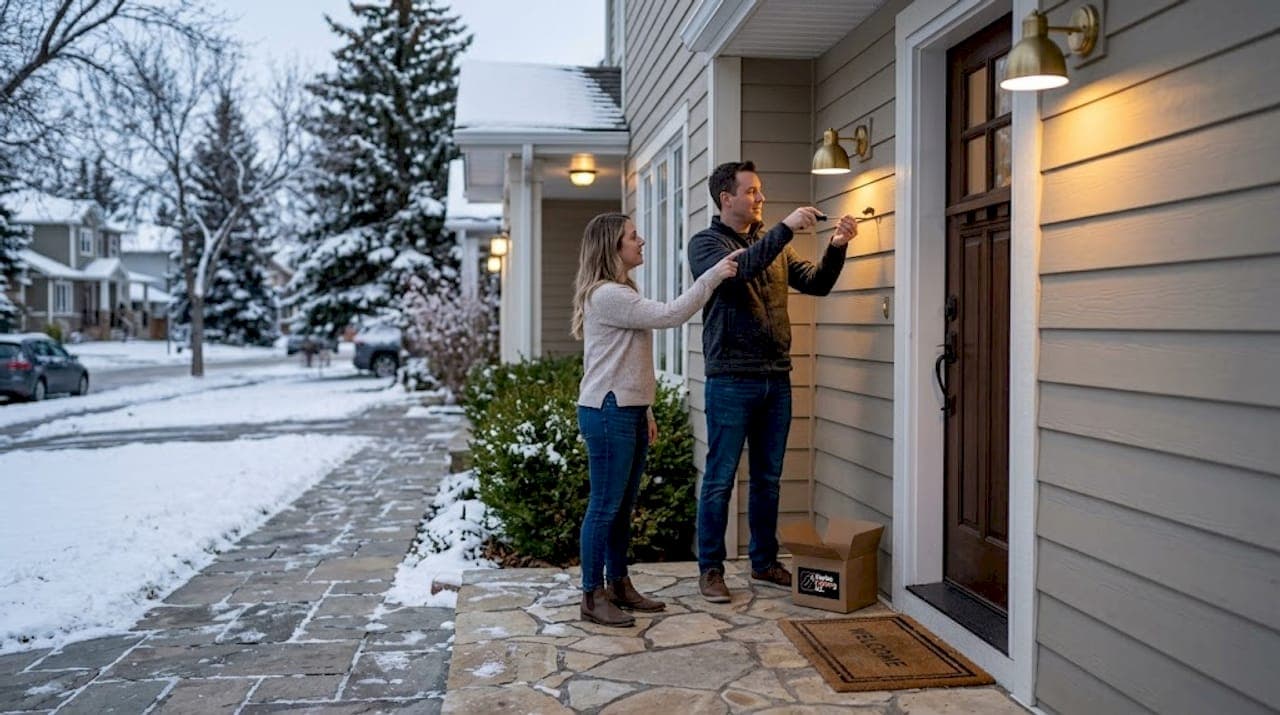
- Proper placement of outdoor lights improves safety, curb appeal, and energy efficiency.
- Strategic positioning around entry points, landscaping, and architectural features creates a balanced, inviting look.
- Working with professionals ensures optimal layout, long-term durability, and maximum home value.
Most Calgary homeowners think outdoor lighting is simple: add more fixtures, get more light. But brightness alone rarely does the job. Where you place each light determines how safe your property feels after dark, how stunning your home looks from the street, and how much you pay on your electricity bill every month. Placement is the real lever. This guide walks you through exactly how to use it, with practical strategies built for Calgary homes, real examples, and the kind of advice that makes a visible difference from the very first night your lights come on.
Table of Contents
- Why placement matters: More than meets the eye
- Enhancing curb appeal: Placement that makes your home shine
- Lighting for safety and security: Protecting what matters
- Maximizing efficiency: Energy-smart placement strategies
- From plan to practice: Calgary's best lighting layouts
- A lighting expert's view: What most homeowners miss about placement
- Ready to transform your exterior?
- Frequently asked questions
Key Takeaways
| Point | Details |
|---|---|
| Placement drives impact | Where you put your lights shapes curb appeal, safety, and energy use more than the type of fixture. |
| Target key home features | Focusing lighting on walkways, entrances, and landscaping gives the best visual and functional returns. |
| Efficiency saves money | Thoughtful placement and LED technology can lower your power bill and maintenance needs. |
| Professional planning pays off | A well-designed layout by experts maximizes every dollar spent on permanent outdoor lighting. |
Why placement matters: More than meets the eye
There's a persistent myth in home improvement circles: more fixtures equal better results. Homeowners add light after light hoping to solve dark corners, only to end up with a yard full of glare, wasted energy, and still somehow a driveway that feels unsafe. The truth is that placement influences both perceived safety and night-time aesthetics far more than sheer wattage ever could.
Placement affects three core outcomes for your home:
- Curb appeal: Lights aimed at architectural features, mature trees, or a well-kept garden create drama and depth. Lights pointed at blank walls or aimed too high produce flat, uninviting illumination.
- Security: A fixture mounted in the wrong spot can actually create dangerous shadows near doorways. Correct placement eliminates blind spots entirely.
- Energy efficiency: Overlapping beams, poorly angled spotlights, and redundant fixtures all waste electricity. A well-placed light does more with less.
Consider two neighbours with identical homes. One installs six floodlights pointing outward from the roofline. The other installs four fixtures, carefully angled to wash the facade, illuminate the path, and graze the landscaping. The second home looks polished, feels safer, and uses less power. That contrast is placement in action.
"The direction and overlap of your light beams matters as much as the fixture itself. Even a small adjustment of 15 degrees can completely change the mood and coverage of an outdoor space." — Lighting design principle used by experienced installers
For inspiration, reviewing top exterior lighting ideas helps you visualise what strategic placement looks like in practice. And if you're comparing products, understanding the full range of lighting solutions for Calgary homes gives you a clearer picture of which fixture types suit which placements.
Pro Tip: Before buying a single fixture, walk your property after dark and note every shadow, every dark corner, and every feature you wish were more visible. That walkthrough is your placement blueprint.
Enhancing curb appeal: Placement that makes your home shine
Well-placed lighting can boost a home's perceived value by up to 20%. That's a significant return for something as straightforward as adjusting where fixtures are mounted.
Certain features respond especially well to tailored placement:
- Walkways and paths: Low-level path lights placed 1.8 to 2.4 metres apart create safe, inviting approaches without flooding the lawn.
- Entry doors: Flanking a front door with two fixtures at eye level produces symmetry and warmth. A single overhead fixture often casts unflattering shadows downward.
- Landscaping: Up-lighting shrubs or trees from below creates striking silhouettes. Grazing a textured garden wall with side-mounted lights adds depth.
- Architectural accents: Soffits, columns, and gabled rooflines all benefit from directed light that traces their contours rather than drowning them in brightness.
Here's how random placement compares to targeted lighting:
| Feature | Random placement | Targeted placement |
|---|---|---|
| Front facade | Flat, washed-out look | Dimensional, dramatic |
| Walkway | Uneven light pools | Consistent, inviting path |
| Entry door | Single overhead glare | Balanced, welcoming glow |
| Garden beds | Ignored or over-lit | Highlighted focal points |
| Energy use | High, overlapping beams | Efficient, purposeful |
Symmetry matters more than homeowners expect. When fixtures are unevenly spaced or aimed inconsistently, the eye picks it up immediately, even if the viewer can't articulate why the home looks off. Consistent spacing and matching angles create visual calm, which reads as quality.
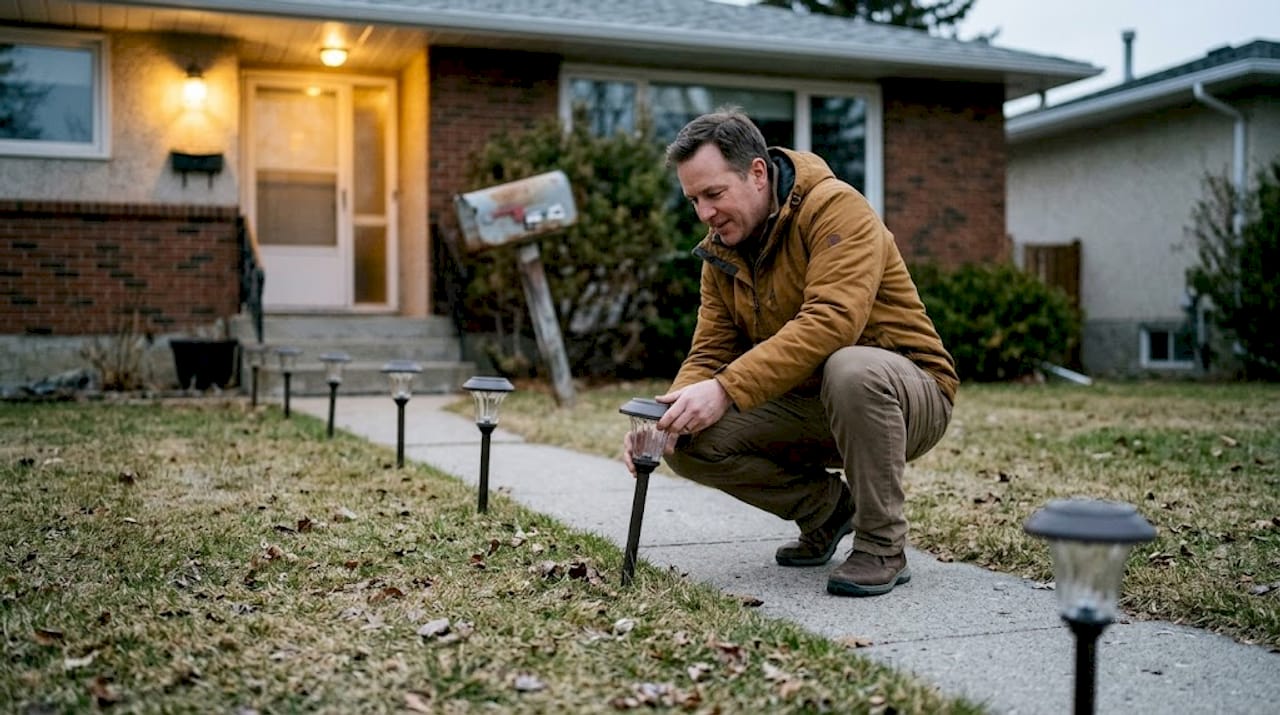
For more exterior lighting ideas that translate directly to Calgary's architectural styles, layering your lighting near entrances is especially effective. Combine a wall-mounted sconce with low-level path lights and a subtle up-light on a nearby tree. That three-layer approach near a single entry point creates a genuinely professional result.
Pro Tip: Use layered lighting near entrances for a professional look. A single fixture is functional; three coordinated fixtures at different heights are transformative.
Lighting for safety and security: Protecting what matters
A break-in rarely happens at noon. Criminals assess a property after dark, looking for shadows to move through undetected. Strategic lighting can reduce home break-ins by 39%, and that statistic comes down entirely to placement.
Follow these steps to analyse and strengthen your security lighting:
- Walk your perimeter after dark. Identify every shadow at entry points, along fences, near gates, and at garage doors.
- Prioritise entry points first. Front door, back door, and side entries should have no unlit angles within three metres.
- Check your driveway. A poorly lit driveway conceals approaching vehicles and people. Side-mounted fixtures at mid-height work better than a single overhead light.
- Assess path transitions. Steps, grade changes, and turns in walkways are injury risks. Low-level lights mounted at each transition point address this directly.
- Consider overlapping coverage. Two fixtures with overlapping beams eliminate the shadow that a single fixture always creates at its edge.
Additionally, proper outdoor lighting significantly decreases slip and fall risks, which matters especially during Calgary's icy winters when dark steps become genuine hazards.
"After we added lighting along the back fence and at the side gate, the whole property felt different. It wasn't just about security. We actually felt comfortable going outside at night." — Calgary homeowner, northwest community
For Calgary's seasonal extremes, the choice between motion sensors and dusk-to-dawn lighting is worth considering. Motion sensors save energy but leave areas unlit until triggered. Dusk-to-dawn fixtures provide consistent coverage all night, which is often preferable near entry points. Reviewing detailed security lighting tips and outdoor LED safety tips will help you decide what combination suits your property. You can also explore the key lighting advantages to understand the full picture of what a well-placed system delivers.
Maximizing efficiency: Energy-smart placement strategies
Optimised placement can save up to 30% in outdoor energy use annually. That's not a small number when you factor in a full exterior system running through Calgary's long dark winters.
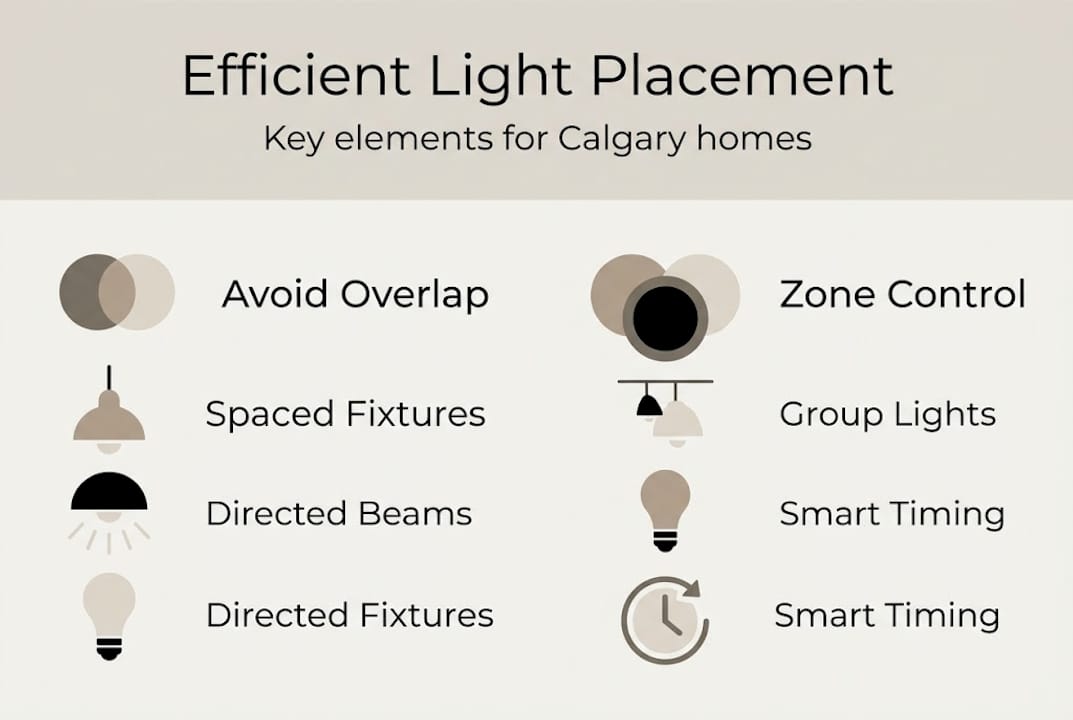
The core efficiency problem is overlap. When fixtures are placed too close together or aimed without intention, their beams overlap extensively. You end up lighting the same square metre twice while leaving other areas dark. Targeted placement eliminates this waste.
Here's how fixture type and placement scenario affect energy use:
| Fixture type | Poor placement | Optimised placement |
|---|---|---|
| LED spotlight | Overlapping beams, 18W used twice | Single angled fixture, 9W covers same area |
| Path light | Spaced too close, excess pooling | 2.1m spacing, consistent coverage |
| Floodlight | Aimed at open sky, 40W wasted | Aimed at facade, 20W effective |
| Soffit light | Pointed straight down, narrow zone | Angled out, wider coverage per fixture |
High-impact efficiency tips worth applying today:
- Use LED spotlights over halogen equivalents. The energy saving is immediate and substantial.
- Install timers or smart controls to avoid lighting an empty property at 3am.
- Add dimmers where ambiance matters more than full brightness, such as near a patio or garden seating area.
- Choose fixtures with the correct beam angle for the task. A narrow 15-degree beam for a feature wall, a wider 60-degree beam for general path lighting.
Pro Tip: Map your property into light zones before installation. Grouping fixtures by zone makes it easier to control, upgrade, and maintain them without touching the entire system.
The permanent LED lighting guide covers the full efficiency case in detail. If you want to understand how installation affects long-term costs, the lighting installation workflow explains the process clearly. For a broader foundation, the outdoor lighting guide is an excellent starting point.
From plan to practice: Calgary's best lighting layouts
Expert planning ensures longevity and maximum ROI for permanent systems. That principle holds whether you're working with a professional or planning a careful DIY install.
Here's a practical process for developing your layout:
- Zone mapping: Divide your property into zones: front facade, entry path, driveway, backyard, and landscaping. Each zone has different goals and should be planned separately.
- Feature identification: List every feature in each zone that you want to highlight, eliminate shadow from, or illuminate for safety.
- Lighting design: Choose fixture types and positions for each feature. Sketch it on a simple site plan, even a rough hand drawing works.
- Night-time testing: Before finalising any fixture position, test with a portable lamp or torch at the planned location. Walk away and observe from the street.
- Adjust and finalise: Make beam angle and position adjustments based on what you see, then confirm final placement before permanent installation.
Common layout mistakes to avoid include placing fixtures too high on the facade (they wash the roof instead of the wall), spacing path lights too close together (creates a runway effect rather than a welcoming approach), and ignoring side and rear elevations entirely.
Professional consultation makes the biggest difference in complex layouts, particularly where roof lines are irregular or mature landscaping creates competing focal points. The professional installation workflow outlines what that process looks like for Calgary homes.
Pro Tip: Always test the night-time effect before final installation. A five-minute test saves hours of remounting and repositioning later.
A lighting expert's view: What most homeowners miss about placement
After working with Calgary properties across every neighbourhood and season, one pattern stands out consistently: homeowners focus almost entirely on the front of the house and forget everything else. The back fence stays dark. The side gate is a shadow. The driveway edge disappears into the night. Then they wonder why the property still feels incomplete.
Subtle adjustments produce remarkable changes. Rotating a fixture 20 degrees. Raising a path light by 30 centimetres. Adding a single up-light behind a garden bed. These are small moves, but they shift how a property feels at night in ways that are immediately noticeable.
The other thing most homeowners miss: lighting isn't just about visibility. It's about emotion. A well-lit home makes you feel proud pulling into the driveway. It makes guests feel welcomed before they knock. It makes you feel safe checking the yard at midnight in January. The installation insights we gather from every project confirm this consistently. A properly planned system changes how a property feels, every night, in every season.
Ready to transform your exterior?
Understanding placement principles is one thing. Having a system designed and installed to deliver those principles with precision, night after night through Calgary's winters, is something else entirely. That's where working with experienced local professionals makes all the difference.
At Starise Lighting, we specialise in permanent lighting systems built specifically for Calgary's climate and homeowner expectations. Our Gen 2 24V LED technology is weatherproof, app-controlled, and designed to last. We also serve homeowners looking for permanent lighting in Edmonton with the same level of detail and quality. If you'd like to see exactly what's possible for your property, exploring our lighting system overview is the best place to start. Request a quote and find out what the right placement can do for your home.
Frequently asked questions
How does light placement affect a home's security?
Strategic placement eliminates shadows at entry points and high-risk zones, making it far harder for intruders to approach undetected. Strategic lighting can reduce home break-ins by 39%, making placement one of the most effective security investments available.
Can the right lighting increase energy efficiency?
Absolutely. Eliminating overlapping beams and choosing LED fixtures over older technologies means your system uses less power for better coverage. Optimised placement can save up to 30% in outdoor energy use annually.
What home features benefit most from outdoor lighting?
Entrances, walkways, driveways, and distinctive architectural details all respond exceptionally well to targeted placement. As research confirms, placement influences both perceived safety and night-time aesthetics, meaning these features become both safer and more beautiful.
Do I need a professional to design my lighting layout?
DIY planning is possible with careful zone mapping and testing, but professional design typically delivers more consistent results. Expert planning ensures longevity and maximum ROI, particularly for permanent systems where repositioning fixtures later is costly.