
TL;DR:
- Calgary outdoor LED lighting must have IP67/IP68 ratings and CSA or ETL certification for harsh winters.
- Proper placement, zone layering, and testing ensure safety, curb appeal, and energy savings.
- Low-voltage (24V) systems are safer and more effective for longer runs in Calgary's climate.
Calgary winters are brutal. Temperatures crash to -40°C, freeze-thaw cycles crack fixtures, and heavy snowfall buries poorly installed systems within weeks. Yet the right outdoor LED lighting does more than survive these conditions — it transforms your home's security, curb appeal, and energy costs all at once. Choosing the wrong fixtures or skipping local bylaw requirements can mean costly replacements or fines before spring arrives. This guide walks you through every step: understanding Calgary's climate demands, selecting the right LED specs, matching your voltage system, and budgeting for a permanent installation that lasts 15 to 20 years.
Table of Contents
- Understand Calgary's climate and lighting requirements
- Choose the right LED lighting: Types, specs, and placement
- Select the safest and most efficient voltage system
- Ensure compliance and budgeting for permanent LED installation
- Our expert perspective: What most outdoor lighting guides miss
- Get Calgary's best permanent LED solutions and expert install
- Frequently asked questions
Key Takeaways
| Point | Details |
|---|---|
| Weatherproof & cold-rated | Choose fixtures with IP67/IP68 waterproofing and -40°C operating temperature for Calgary’s winters. |
| LEDs are best | LED outdoor lights give 80% energy savings and unmatched longevity for permanent home use. |
| Use layered lighting zones | Mix safety, security, and accent lighting to maximize both function and curb appeal. |
| Low-voltage preferred | Opt for 24V low-voltage systems for safer, brighter installations and flexible design options. |
| Compliance saves hassle | Shield lights and check bylaws to prevent fines or neighbour disputes during installation. |
Understand Calgary's climate and lighting requirements
Before selecting fixtures or planning your layout, you need to understand what Calgary's climate actually does to outdoor lighting. This city is not like Vancouver or Toronto. It experiences some of the most dramatic temperature swings in Canada, and your lighting must be built to handle every one of them.
The single most important spec to check is the IP (Ingress Protection) rating. This two-digit number tells you how well a fixture resists dust and water. For Calgary, you want IP67 or IP68 rated fixtures. IP67 means the light can be submerged in water up to one metre for 30 minutes. IP68 goes deeper and longer. Both are suitable for heavy snow and rain. Anything lower risks water intrusion, which causes shorts, corrosion, and early failure.
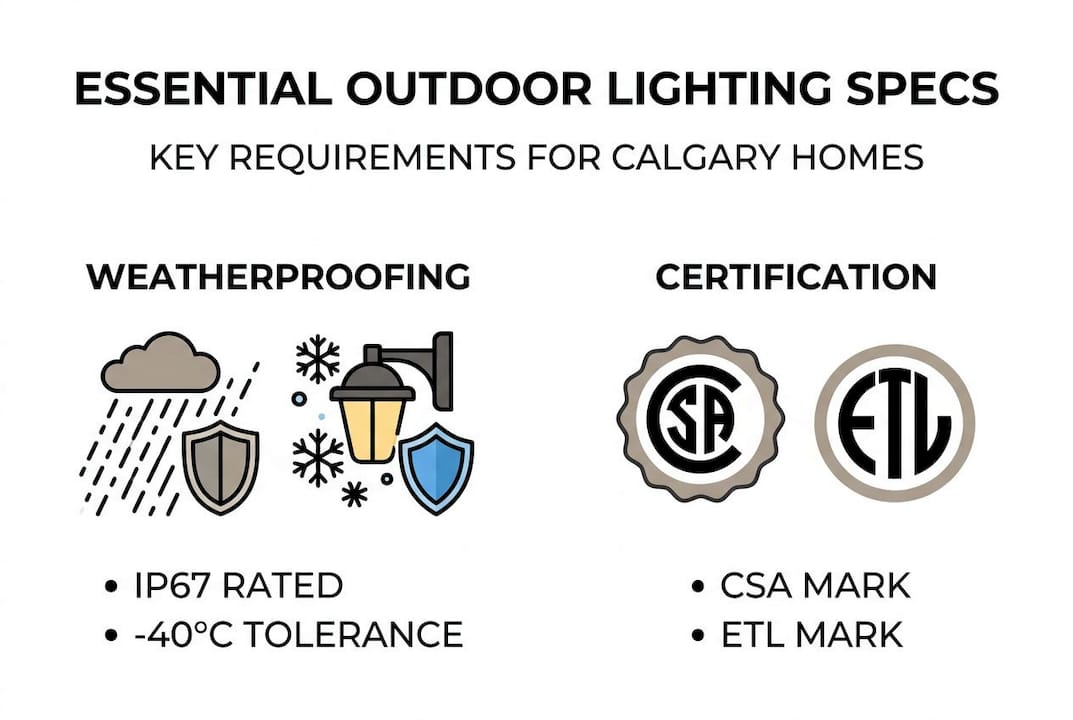
Cold tolerance matters just as much. Calgary's freeze-thaw cycles, snow, and temperatures down to -40°C make proper waterproof ratings and cold tolerance essential for any permanent installation. Look for fixtures explicitly rated to operate at -40°C. Many cheaper imports are rated for -20°C and will fail by January.
Certification is not optional. In Canada, all outdoor electrical fixtures must carry CSA or ETL certification. These marks confirm the product has been tested to Canadian safety standards. Using uncertified fixtures can void your home insurance and create liability if a fire occurs. The advantages of exterior lighting are only realised when the installation is safe and legal.
Calgary also has local rules about how and where you can install lights. The Calgary Community Standards Bylaw requires shielding to prevent light trespass and glare onto neighbouring properties. Violations can result in fines and mandatory removal.
Here is a quick reference for fixture requirements:
| Requirement | Minimum standard | Recommended |
|---|---|---|
| Waterproof rating | IP65 | IP67 or IP68 |
| Cold tolerance | -20°C | -40°C |
| Certification | CSA or ETL | CSA or ETL |
| Shielding | Required by bylaw | Full cutoff fixture |
Key things to confirm before purchasing any fixture:
- IP67 or IP68 rating clearly printed on the packaging
- Operating temperature range includes -40°C
- CSA or ETL certification mark visible on the product
- Fixture design includes shielding to direct light downward
Safety note: Never install line-voltage (120V) outdoor fixtures yourself unless you are a licensed electrician. Improper wiring in wet or cold conditions is a serious fire and electrocution hazard.
Pro Tip: Check cold climate LED tips before finalising your fixture list. Cold weather actually improves LED efficiency, but only if the driver (the internal power component) is also rated for low temperatures.
Choose the right LED lighting: Types, specs, and placement
With Calgary-specific requirements clarified, it is time to evaluate LED types and strategic placement. Not all LEDs are equal, and the wrong spec in the wrong location will leave you with dim pathways, washed-out facades, or blinding glare at your front door.
LEDs are the clear choice for Calgary homes. LEDs use up to 80% less energy and last 25,000+ hours, making them ideal for cold climates where other bulb types struggle. Incandescent bulbs lose efficiency in cold air. Fluorescent lights can take minutes to reach full brightness below -10°C. LEDs reach full output instantly, even at -40°C.
The key specs to understand:
- Lumens: This measures brightness. More lumens means more light output.
- Colour temperature: Measured in Kelvins (K). Warm white (2700K to 3000K) suits entryways and accent lighting. Cool white (4000K to 5000K) is better for security and task lighting.
- CRI (Colour Rendering Index): A score of 80+ means colours look natural under the light.
- Motion sensors and timers: These add security and reduce energy waste significantly.
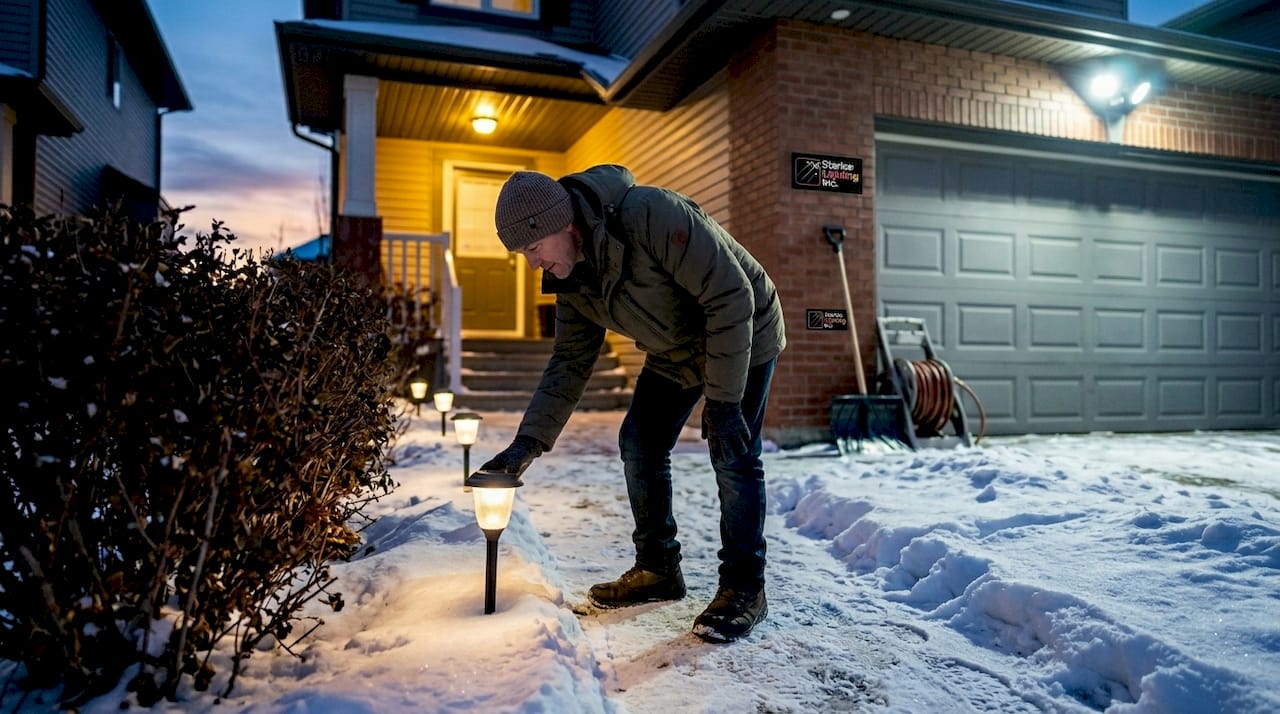
Strategic placement is where most homeowners make mistakes. Layer your lighting zones: paths need 100 to 200 lumens, security zones need 700 to 1,300 lumens, and aesthetic accent lighting falls in between. Mixing these zones creates depth and function.
Here is a comparison of common LED fixture types for Calgary homes:
| Fixture type | Best zone | Lumens range | Notes |
|---|---|---|---|
| Path lights | Walkways | 100 to 200 | Low profile, easy install |
| Flood lights | Security, driveways | 700 to 1,300 | Add motion sensors |
| Soffit/roofline LEDs | Aesthetics, facades | 150 to 400 | Permanent, app-controlled |
| Uplights | Trees, landscaping | 200 to 600 | Directional, accent use |
For placement, follow this sequence:
- Mark all entry points: front door, garage, side gates, back door.
- Identify dark zones along pathways and driveways.
- Plan accent positions for trees, architectural features, or garden beds.
- Confirm each fixture position avoids shining directly toward neighbours or the street.
Explore exterior lighting ideas for inspiration on layering zones effectively. Good placement also improves curb appeal and safety simultaneously, which adds measurable value to your property.
Pro Tip: Always test your chosen colour temperature and brightness level at night before committing to a full install. Tape a temporary fixture in place and observe it from the street. What looks right on a spec sheet can feel very different in the dark.
The combination of curb appeal and security improvements from well-placed LEDs is one of the strongest arguments for upgrading to a permanent system.
Select the safest and most efficient voltage system
Once lighting types are selected, it is crucial to match your voltage system to the layout and safety needs. This decision affects installation complexity, long-term performance, and whether you need a licensed electrician.
Outdoor lighting systems generally fall into two categories: low-voltage (12V or 24V) and line-voltage (120V). Each has its place, but for most Calgary homeowners installing permanent LED systems, low-voltage is the smarter starting point.
Low-voltage systems are safer, easier to install, and offer more flexibility while avoiding voltage drop issues. They run on a transformer that steps down your home's 120V supply to a safe working voltage. If a wire is accidentally cut or a connection fails, the risk of serious injury is minimal compared to line-voltage systems.
The difference between 12V and 24V matters more than most guides admit:
- 12V systems are fine for short runs up to 5 to 10 metres. Beyond that, voltage drop causes fixtures at the far end of the run to appear noticeably dimmer.
- 24V systems can run up to 20 metres without significant brightness loss. For roofline or perimeter installations on larger Calgary homes, 24V is the practical choice.
- Line-voltage (120V) is used for high-output flood lights, commercial-grade security lighting, or installations requiring very long cable runs. Always hire a licensed electrician for these.
Key considerations for your voltage choice:
- Measure your longest planned cable run before choosing a system
- Account for cold-weather performance: low-voltage drivers should be rated for -40°C
- Bury low-voltage cables at least 15cm deep; line-voltage cables require 45 to 60cm burial depth per Canadian Electrical Code
- Store transformers and controllers in a sheltered location to extend their lifespan
The low voltage lighting tips available for Calgary homeowners go deeper on transformer placement and cable management. For anyone focused on improving home safety, low-voltage systems reduce both installation risk and ongoing maintenance.
Key stat: Switching from halogen to 24V LED systems can reduce outdoor lighting energy consumption by up to 80%, translating to meaningful savings on your monthly utility bill over a Calgary winter.
Pro Tip: If you are running multiple zones from one transformer, always calculate the total wattage load first. Overloading a transformer shortens its lifespan and can trip your breaker on cold nights when LED drivers draw slightly more current at startup.
Ensure compliance and budgeting for permanent LED installation
The final step is to ensure your installation is compliant and budgeted for durability and long-term savings. Skipping this step is where many homeowners end up paying twice.
Compliance checklist before installation begins:
- Confirm all fixtures carry CSA or ETL certification.
- Verify IP ratings meet IP67 or IP68 for all exterior locations.
- Check that fixtures include shielding to prevent light trespass onto neighbouring properties.
- Review maximum mounting heights in your zone (typically 4.5 to 6 metres for residential).
- Confirm low-voltage installations do not require a permit in Calgary (they generally do not, but verify with the City for your specific project).
For line-voltage work, always hire a licensed electrician and pull the appropriate permit. Unpermitted electrical work can create serious problems when selling your home.
Bylaw reminder: Fines for improper outdoor lighting installations in Calgary range from $100 to $300 per violation. Shielding failures and excessive glare are the most commonly cited issues. Compliance costs far less than enforcement.
Budgeting for permanent LED systems requires thinking in decades, not months. Permanent roofline installations run $3,000 to $8,000 installed, with LEDs offering a 15 to 20 year lifespan and saving $3 to $5 per month on energy. Over 15 years, those monthly savings add up to $540 to $900, partially offsetting the initial investment.
Here is a realistic cost breakdown for a typical Calgary home:
| Component | DIY estimate | Professional install |
|---|---|---|
| Low-voltage pathway system | $300 to $600 | $800 to $1,500 |
| Roofline LED system (permanent) | Not recommended DIY | $3,000 to $8,000 |
| Security flood lights (2 to 4 units) | $150 to $400 | $400 to $900 |
| Smart controller or app system | $100 to $300 | Included in pro quotes |
When choosing an installer, ask specifically about CSA/ETL certified products, experience with Calgary winters, and whether they warranty both labour and materials. The permanent lighting cost guide breaks down pricing in more detail. Understanding the full lighting installation workflow helps you ask the right questions and avoid surprises.
Our expert perspective: What most outdoor lighting guides miss
Most guides stop at spec lists and placement diagrams. After working with Calgary homeowners through multiple seasons, we have seen patterns that no spec sheet prepares you for.
The most underestimated issue is voltage drop on cold nights. When temperatures fall sharply, LED drivers briefly draw more current at startup. If your transformer is already near its rated capacity, this surge causes flickering or tripped breakers. Size your transformer to 80% of its maximum rated load, not 100%.
Controller placement is another overlooked detail. Mounting a smart controller on an exposed north-facing wall in Calgary means it faces -40°C winds all winter. Even controllers rated for cold weather last longer and perform more reliably when mounted inside a garage or sheltered enclosure.
Here is the contrarian truth about cold weather: cold actually boosts LED brightness, but controllers must be tested indoors and CSA certification confirmed for electrical safety. LED chips run more efficiently at lower temperatures. Your lights will genuinely look better in January than in July, provided the rest of the system is properly installed.
CSA certification is not just a legal checkbox. Insurance companies increasingly deny claims related to electrical fires where uncertified components were used. For curb appeal and security tips to deliver their full value, the system underneath must be built to code.
Get Calgary's best permanent LED solutions and expert install
You now have a clear picture of what a proper permanent LED installation requires in Calgary. The next step is working with people who have done it hundreds of times across this city's toughest winters.
Starise Lighting specialises in permanent outdoor LED systems built specifically for Calgary homes. From zone planning and bylaw compliance to Gen 2 24V technology with app control, every installation is handled by certified professionals who know what Calgary winters demand. Whether you are starting with a Calgary LED installation quote or want to review the Calgary LED cost guide before committing, the team is ready to help you make a confident, informed decision for your home.
Frequently asked questions
What is the best type of outdoor lighting for Calgary homes?
LEDs rated for -40°C with IP67 or IP68 waterproofing and CSA certification are the best choice. They use up to 80% less energy and last 25,000+ hours, making them ideal for Calgary's extreme climate.
What permits or bylaws apply to outdoor lighting in Calgary?
Low-voltage installations generally do not require a permit, but all lights must be shielded to prevent light trespass. The Calgary Community Standards Bylaw sets out shielding and height requirements that every homeowner must follow.
How much does permanent outdoor LED lighting cost in Calgary?
Roofline LED systems cost $3,000 to $8,000 installed, with a lifespan of 15 to 20 years and monthly energy savings of $3 to $5. The long-term ROI is strong compared to seasonal lighting that requires annual labour.
Should I choose 12V or 24V low-voltage lighting?
24V is the better choice for runs over 15 metres because it prevents voltage drop and maintains consistent brightness. 12V vs 24V systems differ most noticeably on longer roofline and perimeter installations where dimming at cable ends becomes a real problem.